There has been much said over the last couple of days about the sad death of Adam Yauch. What I have to offer is inconsequential, so I will keep it short, although I could say much.

I have followed the Beastie Boys since I first bought Licensed to Ill in 1986 as a Christmas or Birthday present for my brother—at his request, I’d never heard of them—and gave it a spin before I wrapped it up. From that moment, they continued to broaden and redefine my music tastes. There was almost no (popular) musical genre they wouldn’t attempt, either outright, or to try and fold it into their own aesthetic. I was lucky enough to get to see them live at Brixton Academy on the Ill Communications tour, and since that day they have remained the most exciting live band I have ever seen. I owe them a massive debt of gratitude.


Adam Yauch obituary in the Guardian

In reading Fiona MacCarthy’s overview of Bauhaus—the German design school, not the 1980s goth band—in yesterday’s Guardian, several thoughts came to mind, but none more so than that of the blinkered nature of design history. The premise of the article, written prior to the opening of the Bauhaus: Art as Life exhibition coming to the Barbican in May, is best summed up by its closing paragraph where MacCarthy states: “The Bauhaus revival could not be more timely. In a world in which idealism in design and architecture is in short supply, it is good to be reminded of this bold and beautiful experiment in bringing creativity alive.”

Well, it could be (wrongly) argued there is a lack of idealism in society in general, and on the surface of it, I agree, there doesn’t appear to be much idealism in design at the moment. However, that is on the surface. If you dig a little deeper, there are plenty of critical design thinkers and practitioners out there, just as there always have been. Unfortunately, they don’t get given enough media coverage outside of Eye magazine and design blogs for their thoughts and work to be taken note of.

Leaving talk of radicals such as Occupy Design to one side for the purposes of this post, one group of designers that I’ve been following recently that I believe do show an idealistic streak has been Government Digital Services (GDS). I first took notice while following Ben Terrett’s Noisy Decent Graphics blog. Terrett recently left Wieden+Kennedy, an advertising agency, to become head of design for GDS, a Government department looking at how digital services are delivered, and in no small way has announced that the GDS remit is as big as that of Margaret Calvert and Jock Kinnear, the designers that transformed the road signage system in the UK in 1950s. Terrett says: “Before they [Kinnear and Calvert] came along Britain was littered with different signage systems all using different symbols, colours and typefaces which was at best confusing and at worst dangerous. With an exponential increase in vehicle traffic the government knew something had to be done. Kinnear and Calvert proposed one consistent system. One designed with the clarity of information as it’s goal. From then on Britain had a solution that became the definitive standard and was copied around the world.” Bringing us back to 2012, Terrett goes on the state: “Sound familiar? Swap signage systems for websites. Swap vehicle traffic for online traffic.” Anyone who has used the navigation nightmare that is Directgov should be able to sympathise with this analogy.

So, what are GDS doing? Well, firstly, they have set up a blog that details what they are up to. You can sign up for regular email updates that informs you of key developments, discussions and advances in their work. This, in itself, is fascinating, regardless of what they are doing, as you can witness the design process in action, which is extremely rare. One recent post discussed how the homeless access, and can make use of, digital services. This is an important consideration as more and more content is becoming embedded in online delivery, with fewer chances to access services through traditional methods. Therefore, how do those that are marginalised in our society get at what they need when they have limited means to be able to do so? These are important and interesting contemporary debates. But further to just being passive observers of this process of research and development, you, the person receiving the updates, are encouraged to give GDS feedback and get involved in the discussion, and therefore the process.

GDS have also put their thoughts and design beliefs centre stage of what they are doing by publishing a set of Design Principles. This manifesto has ideals at its core, ideals for making Government delivered digital services work for the end user; efficiently, transparently, functionally. Practicing Form Follows Function, the Bauhaus masters would be pleased.

Other than a blog, the big plan for GDS is to replace Directgov with Gov.uk. To advance this, GDS have set up a beta site for anyone to tryout and feedback to them. It puts cookies and a search engine at the heart of its operation, to make it as efficient as possible. The wider the demographic, and people with differing digital competencies, that trail this, the better. Only skewed results will come from design and Internet savvy audiences—so if your granny doesn’t go online much, get her to use it and give some feedback. And even if you can’t be bothered to give feedback, just by using the site, you will automatically be feeding back by your actions, as one of the GDS design principles is to design with data.

This is an exciting design led project, especially one that could be considered for such potentailly dry subject matter. So, while I’m on the verge of booking my tickets for the Bauhaus exhibition, I don’t believe we can afford to write off idealism in design because we only relate it to a specific timeframe seen through the blinkers of design history teaching. Today, tomorrow, yesterday; all are equally important if we want to engage people with design and further any discussion about its importance to society. However, the trouble with design history and its attempts to engage non-designers is that it is far too often stuck in the past.


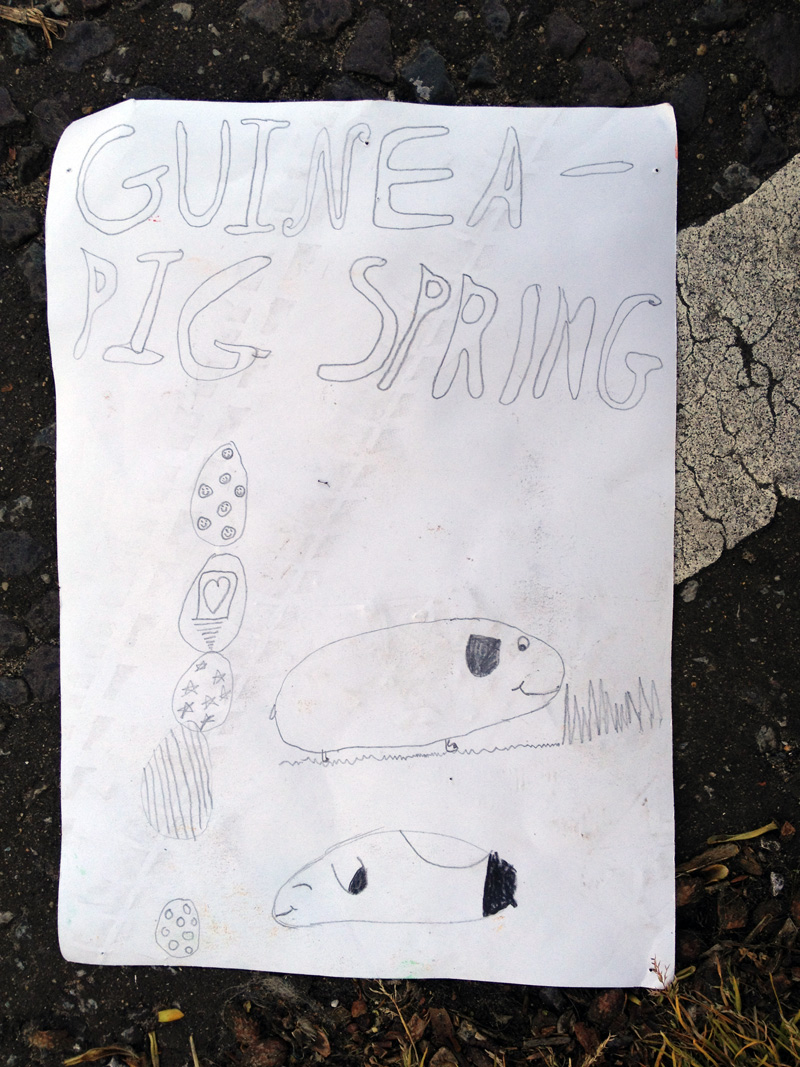
I found this in the street on the way home tonight. Is this the work of a future graphic designer? And is this championing some sort of rodent uprising I was unaware of?


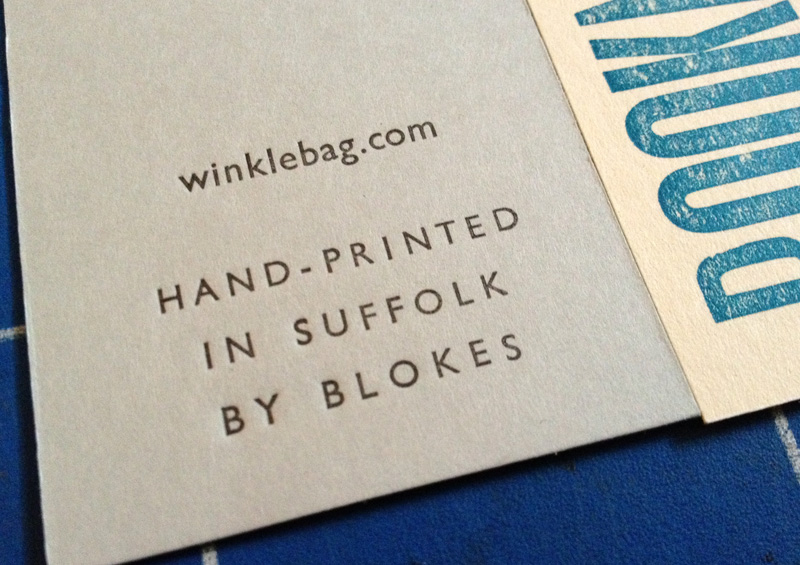
A big thank you to Michael Dobney for showing Claire and I round the rather wonderful Winklebag this Sunday, a very small letterpress set up in the heart of beautiful Suffolk countryside.

After reading a post I wrote here a while ago about a ‘printing for all’ workshop at the Museum of East Anglian Life, where he also volunteers, Michael got in touch and invited us out for a visit.

Winklebag is a rather inspiring set up, particularly for an ex-printer like myself, and I am now itching to conjure up a job I can put through there. Watch out anyone who commissions Dubdog in the near future, you could be going down an inky route.

It was doubly interesting to see a small tabletop Adana press, which I’ve been reading a lot about recently for my archive blog of old print and type advice books: The Small Letter. Below is an illustration of the Adana “Eight–Five” from the “Beginners Guide to Design in Printing” by Leslie G. Luker, (an Adana publication, as many of them seem to be).

Once again, many thanks to Michael for his time, coffee and chat. Check out Winklebag’s website here.

Saw this interesting For Sale/To Let sign in Ipswich yesterday. I’ve often seen adverts painted on the side of old buildings—faded through the ages and now referred to as ‘ghost typography’—but never an estate agent’s pitch. The ‘out of register’ effect is particularly intriguing.


In honour of Record Store Day, I’m posting what is probably one of the best slabs of 7″ vinyl I own—The Slits, I Heard it Through the Grapevine. When I first bought it, it didn’t leave my turntable all day, I had to keep replaying it over and over again as I was so mesmerised with it. It wasn’t until the next day that I discovered the (almost) equally brilliant Typical Girls on the other side.


Independant record stores were important places for me when I was in my teens. I’d go to the major stores and wonder at the LPs I couldn’t afford, then go to an independant store that sold second hand and underground records that I could ‘nearly’ afford. It was always intimidating, the older guy behind the counter—always a guy—whom it was assumed had all the knowledge there possibly was to be had about any musical genre. Teenage insecurities bought worries that they would judge you on your purchase. There I discovered much music, both being played on the in-store record player, and through taking a risk on the album art alone. I made some massive mistakes, but also some wonderful discoveries. Much of my collection at this time was built from money made on my paper round and Saturday Tesco’s job, prior to being on the dole. It therefore consisted of a lot of anarcho-punk, mostly because many of the bands had a ‘pay no more than’ policy printed on their sleeves, and partly because I was aggrieved as a grumpy teenager at just missing out on being old enough to be a first generation punk, so this was the nearest I could get.

Anyway, I won’t be going to my local record store today as I don’t have a turntable anymore and most of my music habits can be satisfied without leaving my home. However, I hope record stores do well out of the event, and survive into the coming year. They helped form a part of me.

If you are in Brighton, I can highly recommend Rounder Records, I always ensure a visit if I’m down that way. Closer to (my) home, and I’m not sure if they are involved in Record Store Day or not, but Out Of Time Records in Ipswich comes highly recommended, especially for all things reggae.

Sadly, designer and director Hillman Curtis passed away on 18 April. While I wasn’t overly familiar with his name, I knew his work. In fact, he directed one of my favourite films of 2010, David Byrne’s Ride, Rise, Roar. If you haven’t seen it, I urge you to as Curtis successfully captured the meeting of many creative minds in this highly engaging music/dance documentary.


In the video below, Curtis talks about his work process and creative beliefs, citing limitations and constant reinvention as being central to his creativity.


Go here for more about the man and his work.

Dubdog has packed its doggy bag and decided to move kennel. Since starting to blog in 2006, I’ve covered many things, but as the nature of what I write about, and how I write, has changed over the years, I have decided to up sticks from Blogger and hang up my collar over here at WordPress. Blogger has served me well over the past six years, and I would recommend it to anyone starting out, but I’ve come to the decision that WordPress has a greater respect for how it displays images and deals with third party media, as well as having more professional themes on offer. Thanks to WPShower for designing this one.

For those that are new to Dubdog, welcome to the pound. I hope you will return regularly as things unfold here. If you want to check out what I do, the old site will be archived at Blogger until they decide to close it down for non-activity. You can access it here, should you wish to, and there will remain a link from the About page on this site. There, you will also find links to my other online activities. Feel free to sniff around.

If you are an existing reader, much will be familiar to you. There will still be design critiques, posts about things I come across on a day-to-day basis, exhibition and conference reviews, typographic tantrums, and histrionic rants about whatever is pulling my tail at any particular moment. Music will continue to feature heavily. However, gone is the ‘anticipating’ list—I got fed up of posting exhibitions there and not getting round to seeing them. Current listening habits will now feature as a monthly round up and I’m currently in the planning stages of creating a dedicated page to reading habits.

Welcome to the doghouse.