Archive

Exhibition

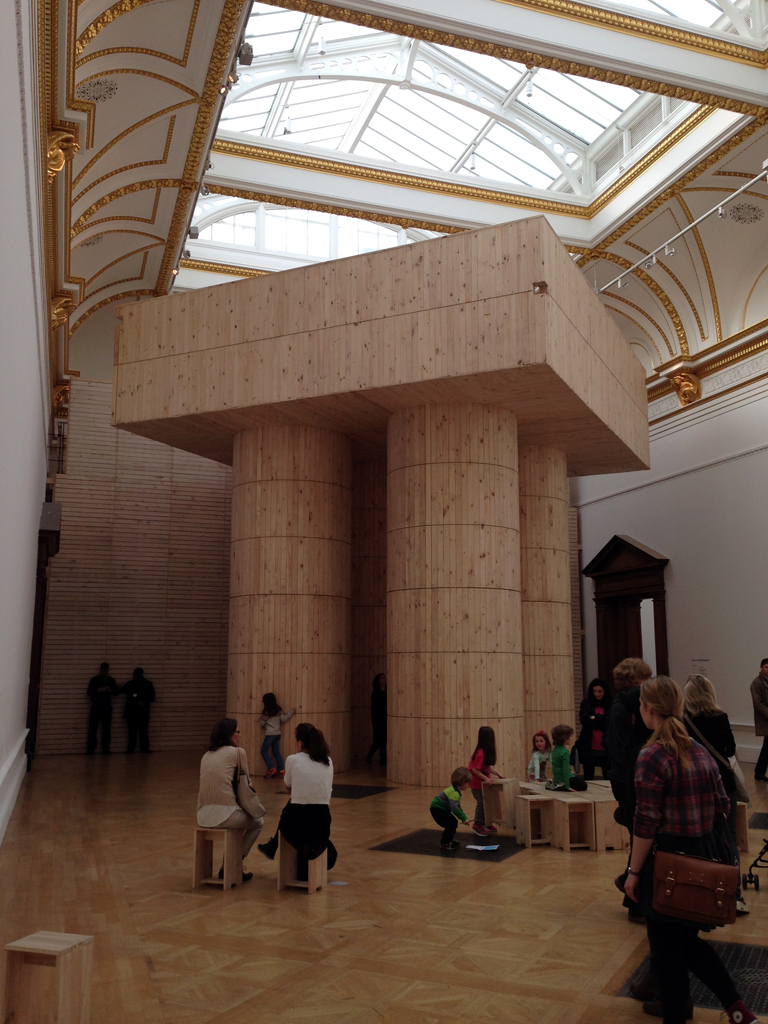
LynchI spent a very agreeable Saturday with my friend Liz a couple of week’s ago visiting various exhibitions in London. The main objective was to catch the Warhol, Burroughs and Lynch shows at The Photographers Gallery, but we also took in the Royal Academy’s Sensing Spaces, before making the unwise decision to take in the Portrait Gallery on the first sunny day of the year on a busy Saturday afternoon.

The Photography Gallery shows were a mixed bunch. I thought the Warhol exhibition was largely pointless, with the images being shown more because they were by Warhol rather than because there was anything inherently interesting in the photographs themselves. The only shots that really made sense to exhibit, in my opinion, were the ones where Warhol had repeat printed and stitched together creating gridded montages much like some of his screenprints. At least with these there was some tangible link to how he approached the physical production of other works of his. I also thought the Lynch show was boring. Photographs of abandoned and derelict buildings, albeit expertly shot, were dull in the extreme. In fact, I would go as far as to say they were pretentiously dull; shot entirely in black and white I felt he was trying too hard to create ‘art’, and it was all a bit like looking at a 1980s British Journal of Photography annual. However, well worth the entrance fee alone was the Burroughs show. Of the three, he was the only artist who gave the sense he was truly experimenting with the medium, testing and pushing the capabilities. And the shots themselves had a far stronger narrative. While Warhol was playing and Lynch was trying too hard, Burroughs was exploring a medium and seeing what it could do and what he could produce.

RADiébédoFrancisKéréOver at the Royal Academy the Sensing Spaces: Architecture Reimagined show was a blast. Each room had a different theme, and you were encouraged to be interactive with the work. As you walked around each exhibit created a different atmosphere in their given spaces which engaged the viewer and took them with the work. There could have been no more an explicit introduction to the uninitiated as to the power of architecture to influence moods and behaviour. For example, the image above of Diébedo Francis Kéré’s piece encouraged visitors to stick brightly coloured straws into the structure to create a furry, fun walkthrough. While the mausoleum  solemnness of Grafton Architects’ main room stopped people in their tracks, slowed them down and made them gape upwards in astonishment, (see below).

RAGrafton3And Pezo von Ellrichshausen’s monstrous wooden beauty could be climbed via a ramp or spiral staircases in the legs, which allowed a closer view of the Academy’s architectural gilding linking the imposing structure with the building that housed it and bringing a greater appreciation of everyone’s surroundings.

RAPezovonEllrichshausenWhile I wasn’t overly impressed with two of the shows at the Photography Gallery, I would still highly recommend a visit, and the Royal Academy is only a short 5-10 minute walk away, which would be a shame to miss while it is still on.

Warhol, Lynch and Burroughs is on at the Photographers Gallery until 30 March.

Sensing Spaces is on at the Royal Academy of arts until 6 April.

More photographs over on Flickr.

We_Are_Invite_CGGraduates from the Graphic Design and Graphic Illustration courses at UCS Ipswich are taking their end of year show, We Are, to London’s Coningsby Gallery next week. The show will featuring work from their time on the course as well as new work completed since graduating.

The show is the result of the overwhelming success of an International Design Auction that students held last December, when they managed to blag work from such luminaries as Jonathan Barnbrook, Brian Grimwood and Gerald Scarfe, among many others.

The show opens to the public on 12 November and runs daily until Friday 15 November from 10:30–18:00.

The Coningsby Gallery, 30 Tottenham Street, London, W1T 4RJ

www.coningsbygallery.com

Watch this space for details about a follow up International Design Auction being held by current final year Graphic Design students at UCS Ipswich to be held on 27 November.

To start the new academic year off with a shot of inspiration, we took all Graphic Design and Graphic Illustration students at UCS to GRAPHICS, the Romek Marber exhibition at The Minories in Colchester.

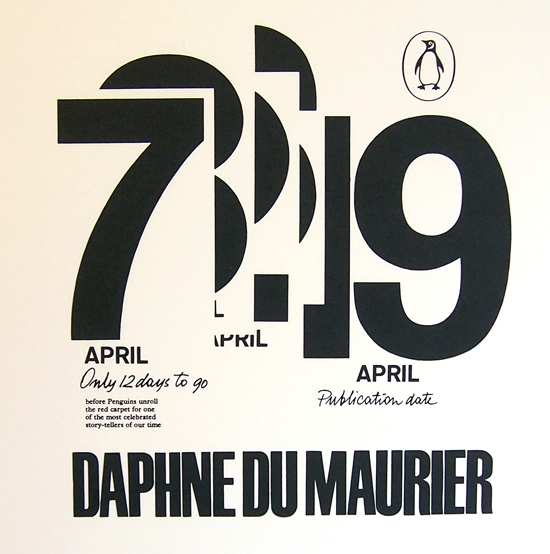
OLYMPUS DIGITAL CAMERAMarber’s influence on British Graphic Design can not be underestimated. His most famous work was for Penguin Books, particularly their crime series, producing many of the iconic green covers utilising photography, collage and drawn imagery to full effect to capture the title of each book he designed for. He also famously designed one of the grid systems that Penguin used for many years.

OLYMPUS DIGITAL CAMERAAmong the covers on display was also his rationale behind the layout. As the exhibition literature states: “Romek Marber’s work often communicates in a clear and direct manner that is bought by combining a stripped down use of colour with well defined formal structures within which text and image are framed. A sense of pragmatism and design that grows out of necessity in terms of delivery of message results in an efficient visual imagery that wastes nothing but at the same time appears to leave nothing out.”.

OLYMPUS DIGITAL CAMERASome of Marber’s typographic work balances a tightrope between experimentation and reductive modernist austerity, clearly influencing many designers working today. In fact, the covers he did for The Economist only look dated because of the mastheads—Marber’s type explorations themselves could grace many contemporary magazines and certainly wouldn’t look out of place on Bloomberg Business Week.

OLYMPUS DIGITAL CAMERAAnd this film title sequence could be mistaken for some of the experimental and fluid graphic illustration coming out of the UK at the turn of 21st century by the likes of Dávid Földvári et al:

OLYMPUS DIGITAL CAMERAGRAPHICS exhibition is highly recommended, and runs until 25 October: details here. Thanks to Cydney and Kaavous at The Minories.

While in Colchester, and with the Firstsite Gallery a stone’s throw from The Minories, we also took the opportunity to take a look at the Xerography exhibition that is on there. This celebrates the role of photocopying in art, from the 1960s through to the modern day.

OLYMPUS DIGITAL CAMERAThis show has an impressive list of 40 contributors, and naturally for graphic design students, the more graphic and book orientated work seemed to appeal the most.

OLYMPUS DIGITAL CAMERAThe Hockney’s were particularly good and of interest to illustrators:

OLYMPUS DIGITAL CAMERAAnd I was really taken with this mail-art piece by Eugenio Dittborn:

OLYMPUS DIGITAL CAMERAThe show is mixed enough for something to appeal to everyone, although I doubt that there would be anyone who would like everything that was on show. But despite its breadth, the one obvious omission for me was the lack of graphic design. For an exhibition which is tied together by the process of using a photocopier to produce work, this seems like a massive black hole. For example, there are no punk era fanzines such as Mark P’s Sniffin’ Glue which helped to define the aesthetic of an era. This form of instant publishing also helped to introduce some to a career in graphics, such as Terry Jones. There were also no rough and ready record sleeves, whether by the likes of practicing designer Linder Sterling or by the many unknowns who embraced the Do It Yourself nature of punk in 1976/77.

Omissions aside, this is a worthwhile exhibition to go and see, especially if you can go when the Marber exhibition is still on at The Minories, as the juxtaposition between the two makes for refreshing contrast. Xerography runs until 10 November, details here.

Thanks to Sue Hogan for the student talk.

Well, I’ve been back at the day job for a week now and my summer holiday seems like a distant memory. So before it stretches back any further, I thought I should post some of the cultural highlights from our two weeks away.

First up, we stumbled across the Bubble Car Museum when in Lincolnshire, and what a find. I wasn’t sure what to expect, and all I really hoped was that they had a Bond Bug, because I had a Dinky toy version as a little boy. But it has to be said, this was a gem of a little museum.

OLYMPUS DIGITAL CAMERAFrom the outside the museum looked like a small shed, and I half expected to just see a few rusting, half refurbished cars. But no, the place was rammed with these amazing vehicles. There was something optimistic about these 700cc or less cars and bikes—futuristic and weirdly beautiful. And the museum curators had done an excellent job of displaying them all, trying to put them into context with mock-ups of 1950s shop fronts, front rooms and kitchens around the two exhibition rooms.

OLYMPUS DIGITAL CAMERAThis museum is highly recommended and it has a great little no nonsense cafe with adjoining campsite. I think we might be bringing the tent next time we visit Lincolnshire.

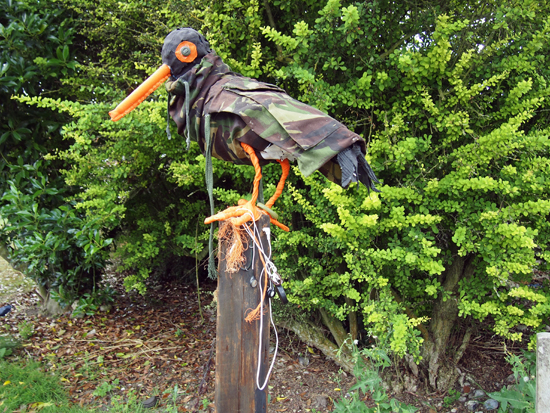
On the drive home, as mentioned here, we went via the north Norfolk coast. Having holidayed there for several summers we stopped off in Cley-Next-the-Sea hoping to catch their summer art exhibition, Cley 13, usually held in the village church. This year in a field next to the graveyard, as we approached the church, we were greeted by these wonderful bird sculptures.

Created by artist Jessica Perry and the children of Stalham High School, they certainly grabbed your attention. And while there was interesting work on display in the church, it is very much like a very well crafted and presented college foundation course end of year show. Good, but not exactly challenging.  However, these birds were just fun and unpretentious and as a result blew everything else away.

We took a couple days out in London in the second week of our holiday. We were lucky enough to have been bought membership of the Royal Academy as a present so decided to check out the Summer Show for the first time. As I’d only ever seen it on TV before, it was interesting to see it in the flesh, but ultimately, it is a difficult thing to review, what with so much on show. However, it was quite a good way to assess your tastes, as we ended up just looking at what immediately grabbed our attention. With most exhibitions we go to being themed or of a single artist/designer, just letting your instincts and knee-jerk judgements kick in was refreshing, and almost the only way to react to such an overwhelming display of work. I found several pieces that I really liked, but equally was surprised by many of the entries being allow in. An ultimate favourite for me though had to be the Greyson Perry tapestries, most of which were created in response to his TV programme on taste. Seeing them in their full glory, and being able to concentrate of their detail and the narrative they told, only went to confirm my opinion that the man is an illustrator rather than a fine artist, especially with his work deviating from pottery.

While at the RA, we also took the opportunity to see the Mexico: A Revolution in Art 1910–1940, which I loved. It hadn’t had great reviews, but the fact it was a mix of painting and photography, I thought made it a strong documentary on the the changes and difficulties that Mexico faced during this time period.

While in London, we also took in the Ibrahim El-Salahi exhibition, some of who’s drawings blew me away. This was shown alongside Meschac Gaba’s Museum of Contemporary African Art, which was sort of a museum within a gallery.

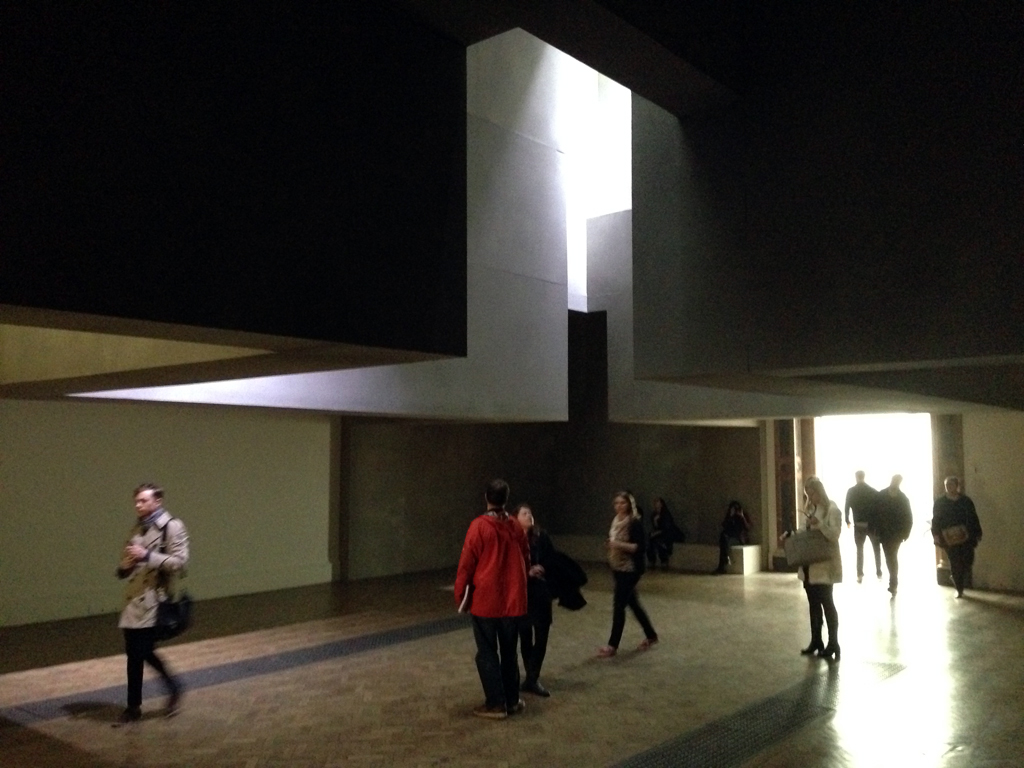
TateGaba’s show was really refreshing, not least because you were allowed to take photographs. Gaba wants to challenge the notion of what a museum/gallery should be, and over the years adds new ‘rooms’ to this travelling show, encourages audience participation, (in the first room there was a large Jenga type game for people to interact with), and showcases his life and work as part of the show, (he even had large scale photographs of his wedding and wedding gifts on display as an exhibit!). I wasn’t overly impressed with his individual pieces of work, with its over reliance on symbolism and a sense of having seen similar approaches done much better, but then the Museum has become an artwork in its own right. As a whole, it is definitely greater than the sum of its parts. And what he is trying to achieve with challenging the notion of an exhibition was a joy to behold and completely refreshing.

Gaba's wedding photographs and gifts

Gaba’s wedding photographs and gifts

Just the fact that I’m able to publish photographs here that I took in the exhibition, and couldn’t photograph anything and publish it here form the, arguable much stronger, El-Salahi show, is testament to breath of fresh air this approach filled me with. Why can’t you take (non-flash) photographs in exhibitions? I’ve always thought it was fucking rediculous.

Lastly, while in London, we met up with Claire’s daughter and they both went off to watch a show at The Globe, which was a present from Callie to her mother for her birthday. So I took myself off the Design Museum. It was a shame because the whole place felt like it was winding down, readying itself for its move across London to its new building in 2014/15. But despite there being an air of the place being unloved, the Future Is Here exhibition was genuinely interesting, once I got my head around what it was about. It basically gathers together examples of new ways of working and designing/producing goods, including crowdsourcing ideas, 3D printing, producing construction materials on a building site, and small scale robot construction. These themes and exhibits, when taken collectively, demonstrated how manufacturing processes are changing around us and how new methods of industry were being formed in the now. The Design Museum was half proposing we are in times of a new industrial revolution, and while I’m not completely convinced, it was a thought provoking experience.

As if to reinforce the feeling that the museum is ‘winding down’, it had on display items from its collection themed into six categories rather than the usual second commissioned exhibition. While it is good to see this work coming out of the closet, and promises much for the new bigger space the museum will have in Kensington, (with some of their collection being on permanent display), it did give the impression that energies and finances were being diverted elsewhere. That said, I naturally made a beeline for the graphic design section, and it was good to see Calvert and Kinneir‘s road signage templates:

Maidenheadand the Design Research Unit‘s branding guidelines for British Rail:
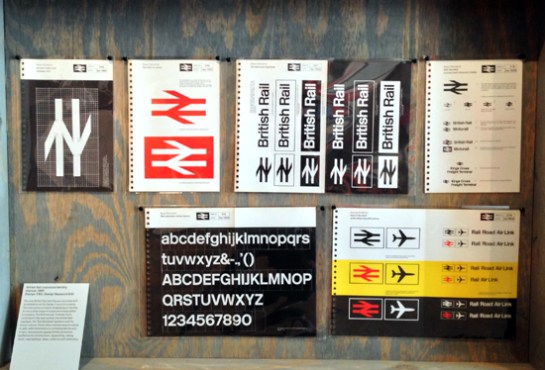
BR

I love the idea of the Art Everywhere project. For the uninitiated, Art Everywhere proposes to fill billboards across the UK with prints of famous art. I like the concept of this because:

Firstly, while not a new idea, it is getting art out of galleries and onto the streets, making it more accessable. *

Secondly, it is democratic, (to a degree). The public can vote on what they want to see displayed on billboards across the nation. * *

Thirdly, it is putting billboards out of commission to advertisers for a period of time—the ultimate culture jam, you could argue. * * *

For more details about the project, head on over to the Art Everywhere website and donate £3 to help make this happen:  arteverywhere.org.uk


* It could be argued that the concept behind this has been borrowed from a recent campaign The Partners did for The National Gallery

* * I would like to know more about the long listing process, and how the decisions were made about what the public can vote on. For example, I was very disappointed to find no Gilbert & George on the list, but then maybe there is already enough shit and piss on our high streets!

* * * When there was an advert ban in São Paulo in 2007 it created an interesting visual and commercial void in the city scape with billboards stripped of their posters—but I always thought that was a waste of space, however intriguing it looked.

The third annual SNAP: Art at the Aldeburgh Festival, is currently on at Snape MaltingsSuffolk, with, as usual, some interesting work amongst the marshlands, dilapidated buildings and tourist tat shops. Worth a visit if you are in the area.

This year, SNAP has a fringe event called SNIP, in a barn a few yards down the road from Snape Maltings, which is worth a look as well. UCS staff and student work is on display.

Bennedict Drew’s projection: Matériel at SNAP

SNAP runs until 30 June

SNIP runs until 23 June

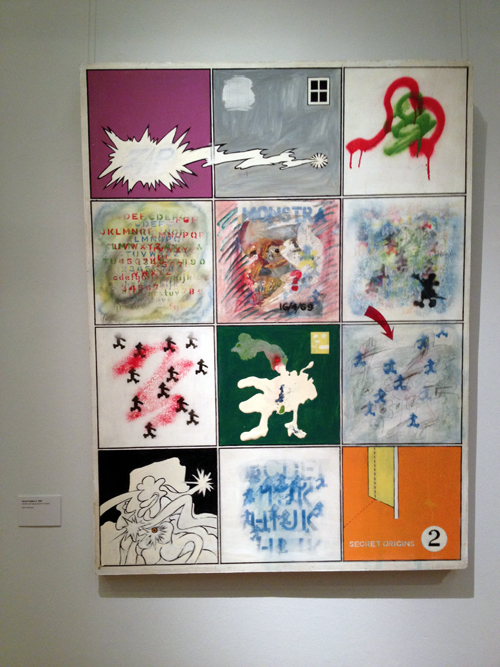
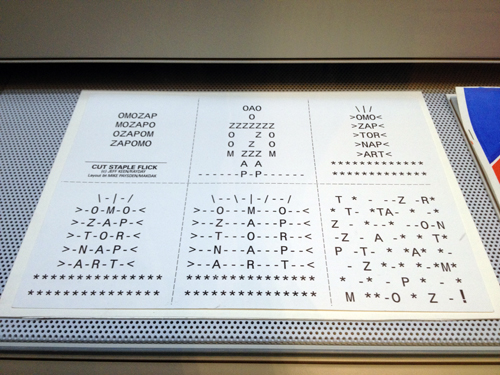
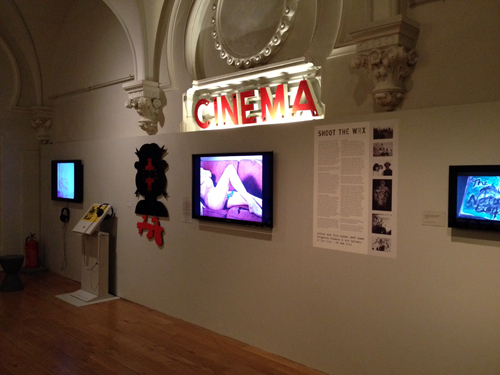
It is always rewarding to come across an artist who has previously been completely off your radar. This was the case when Claire and I stumbled across Jeff Keen’s Shoot The WRX retrospective at Brighton Museum this weekend.

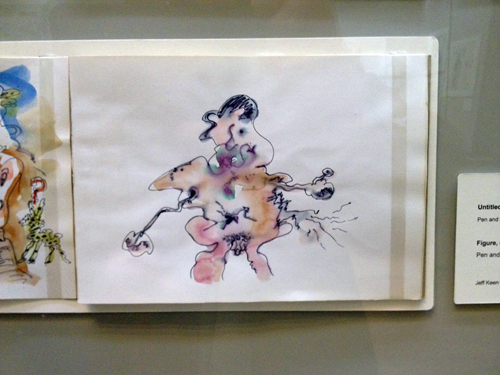
It was an exciting show, with a huge variety of different styles showcased throughout his works, (or WRX, the title referencing Keen’s love of cartoon strips). Without wanting to do the exhibition a disservice, I was immediately reminded of an art foundation course end of year show—the styles were so similar to a whole host of other artists that it was difficult not to see many of the outcomes as emulation, or of someone finding their own reference points through exploring those of others. In fact, as I walked among the projections, objects, paintings and sketchbooks on display, the variety was so great it seemed incredible that all of this was the work of one person.
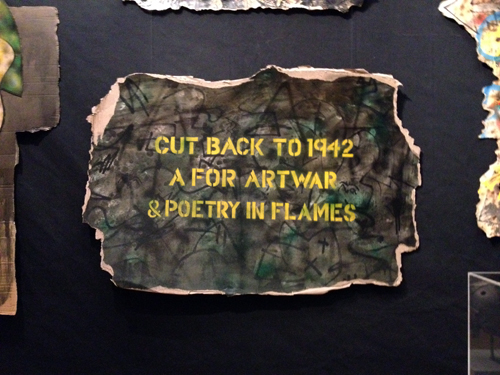
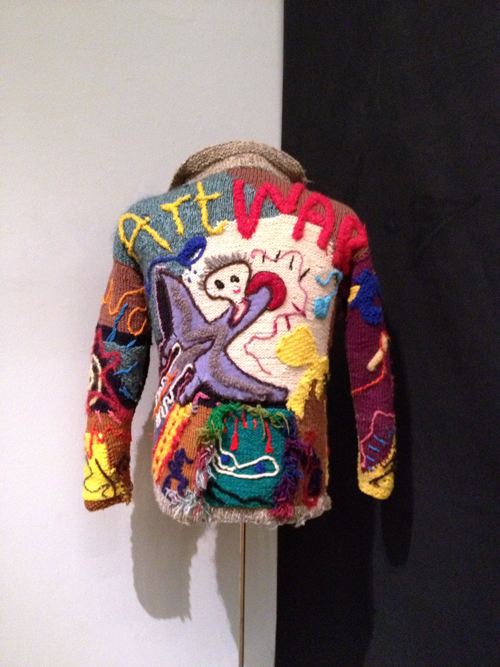
Listing the similarities to other artists; Keith Haring, Basquiat, Kurt Schwitters, Rauschenberg, Picasso, Terry Gilliam, Futurist poetry, punk fanzines, Anselm Kiefer, Robert Crumb…  I noted that the one unifying voice among all of this was the sense of anarchy. In fact the tag line of ARTWAR that adorns many of his pieces suitably sums up his destruction of other’s visual signatures.

The Foundation show is an unkind tag, as Keen’s edit, maturity of application, and consistent sense of chaotic narrative, would rarely been seen at such a level. And much of the work was more than the emulation often displayed in such shows—this was someone in their element, the work vibrant and playful with an underscoring attitude, as opposed to students on a stepping stone to something else.

Keen moved to Brighton in the 1950s and steadfastly refused to leave, and it is unfortunate that he died in June of this year. The energy on display is truly inspirational, and the sheer eclecticism in both medium and approach amazes because in such a show, the sum of the parts becomes the whole. By the time you get to the last film, shown on the balcony opposite the tea room in the museum, it becomes entirely logical that this is the work of one man.
The show runs until 24 February 2013 at The Brighton and Hove Museum and Art Gallery, entry is free.
Jeff Keen’s obituary—The Guardian.

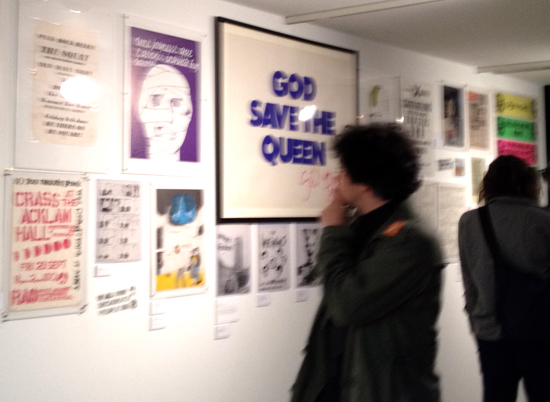
Someday All The Adults Will Die: Punk Graphics 1971–1984, opened at the Hayward Gallery last week.

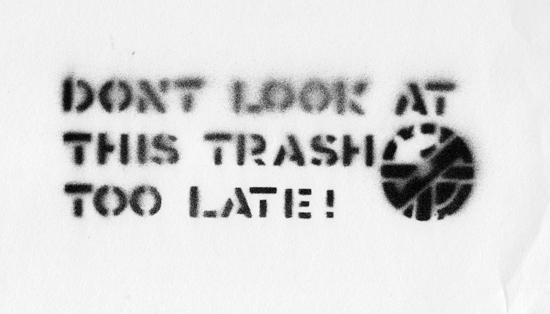
Crass stencil

To coincide with the opening private view, curator Johan Kugelberg hosted a panel discussion of some key designers involved in early punk graphics, along with cyberpunk author William Gibson. Apologising for co-curator Jon Savage’s absence—who was very punk by being on holiday with his mum—Kugelberg introduced Gee Vaucher, who created all the graphics that surrounded Crass‘ musical output, Tony Drayton of Ripped & Torn fanzine fame, and John Holmstrom, the man behind the American Punk magazine.

The discussion was pushed along admirably by Kugelberg, prompting anecdotes from Gibson about hearing both The Beatles’ Sgt Peppers, and Velvet Underground’s first LP within weeks of each other on their release in 1967. He came away thinking the Velvets the more important work because of the shock value it contained, and the fact that lots of people didn’t like it. (I have to say I agree with him.) Holmstrom also spoke about the impact of seeing the Ramones in 1974, and Vaucher about how Freddie Laker’s cheap air fairs helped punk bands play across the Atlantic divide. However, it was strange how music only entered the discussion as a separate entirety from graphic design, and I came away thinking it disappointing that the relationship between the similar creative processes involved in making punk music and punk graphics wasn’t discussed in any depth. This may be a result of Vaucher and Holmstrom’s art school background—they weren’t untutored kids working it out for themselves in the same way that many bands and artists were. While Vaucher’s work may look like photomontage, the anti-art form first championed by Dada artists, it is in fact painted in gouache. But to overlook the relationship between creative approaches to different art forms, and how similar processes arguably tied them together, is a glaring omission.

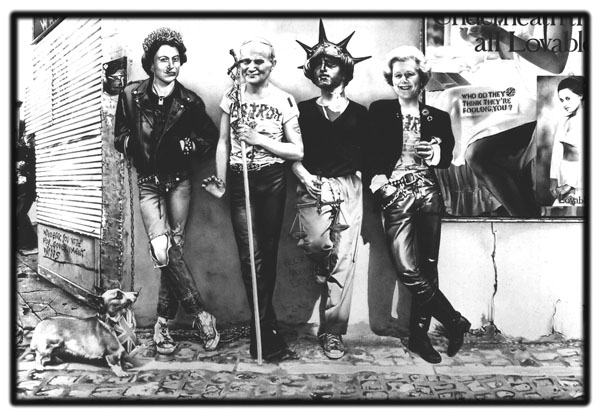
Gee Vaucher’s punk self-commentry—The Sex Pistols become figureheads of the State.

Refreshingly, Tony Drayton, while not explicitly talking about musicianship, or lack of it, did discuss making his first rough and ready Ripped & Torn fanzine, and how speaking to The Damned at the bar of one of their gigs became the interview he would include in one of the issues. Initially being inspired by Mark P’s Sniffin’ Glue, he created his own version using a photocopier at his place of work. Producing only 10 copies, he sent several out to, among others, Compendium bookshop in London, and was then shocked to get a request for 200 more for them to sell. This legitimisation and acceptance into the ‘scene’ was one of the most interesting aspects raised. And in fact, when looking around the exhibition itself, the sense of ‘anyone can do it’ shines through. The buzz of creating something, of it becoming a legitimate artefact through production, something you’d only previously seen professionals making, helped to launch many a career. Sure, there is a lot of poor artwork on display here, as you would expect. But the fact that punk allowed those who hadn’t gone, (or even dreamt of going), to art school to find an innate talent and drive, is one of the truly revolutionary things about the movement, both musically and graphically. Add to this the raw nature of much of the visuals, their aesthetic dictated by limited means of production, and ideas and content rise above concerns about production values. The immediacy, even urgency of the process, is obvious in much of the work throughout the exhibition, which further creates a kinetic energy to what is displayed.

It is good to see that Kugelberg and Savage have included early situationist texts and graphics here too. Debord and Atelier Populaire are on display, along with King Mob, who up until this point I had only read about and never actually seen any of their visual output. The politics of these movements are echoed throughout much of the punk music graphics, particularly that of Crass. These influences are obvious and this fluid idea of what punk graphics are eschews what Vaucher called the ‘BBC or Guardian filter’ of what constitutes punk in mainstream media. The exhibition is also interesting because much of the work wasn’t created with longevity in mind. Thanks to the personal collections of Kugelberg and Dial House, (Penny Rimbaud and Gee Vaucher’s communal house that was home to Crass Records for many years), this important exhibition showcases a period that touches design, music, politics and cultural history, and is available for all to see with the potential of reaching an even bigger audience than much of it did first time around.

Someday… private view

All in all, the discussion panel was thought provoking. I proudly came away with a Crass stencil that Kugelberg had made using an original Crass cut out on display in the exhibition, to raise money for Pussy Riot. The influence of punk, and punk itself, as he claimed, lives on.

Someday All The Adults Will Die: Punk Graphics 1971–1984, continues at the Hayward Gallery, London, until 4 November, and is highly recommended.

P.S Apologies for the poor quality of the private view image—blame the ridiculous ‘no photos’ policy of British galleries resulting in hasty shooting.

I’m vaguely ashamed to say that today was the first time I’ve visited Ipswich Art School since it opened as a gallery in 2010 after years of no-one really knowing what to do with it. Tucked in next to Ipswich Museum off a main thoroughfare in Ipswich, it is a marvellous building, purposefully built as an art school, with an amazing glass ceiling in the central atrium that floods the space with natural light.

Brian Griffiths’ Boneshaker. 2003

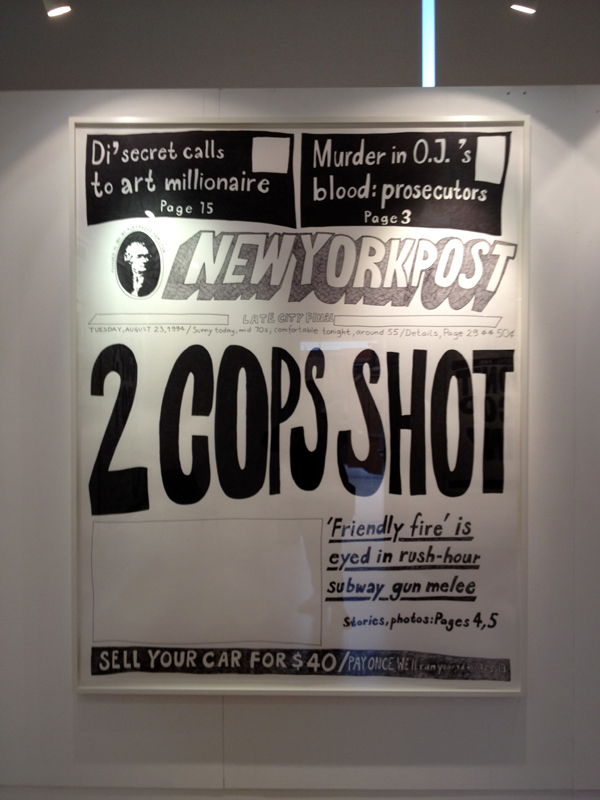
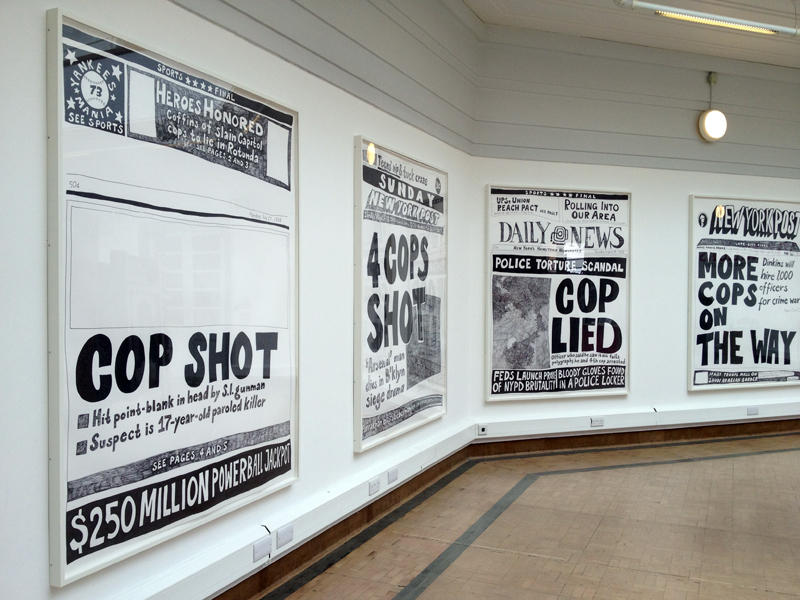
Currently on display is Revisitations, an exhibition of work from the Saatchi Gallery. The Saatchi Gallery first supported the opening of the Ipswich Art School with work for it’s initial exhibition two years ago, and it is good to see the link continuing. In the current show, I particularly liked Brian Griffiths’ Boneshaker, above, entirely made out of old furniture, and Aleksandra Mir’s Newsroom, made of giant drawings from New York newspapers from 1986–2000 and 2007.

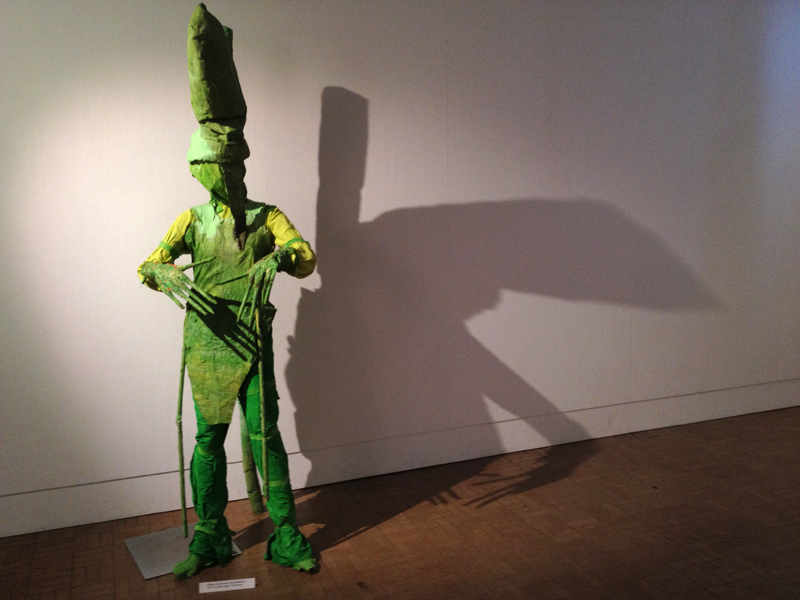
Other highlights include Spartacus Chetwynd’s spooky life-size costumes:

The Lizard, 2004

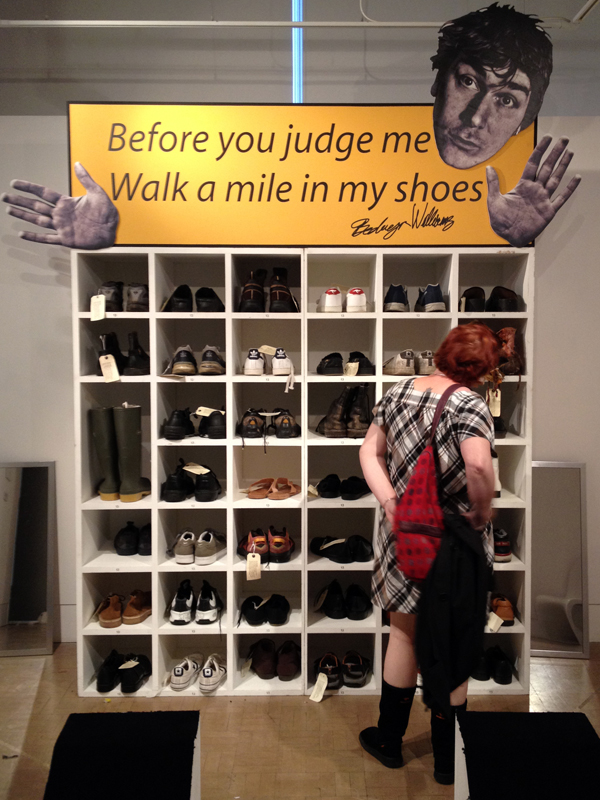
And Bedwyr Williams’ Walk a Mile in my Shoes, which made Claire laugh out loud several times. Visitors are invited to try on items from his personal size 13 shoe collection.

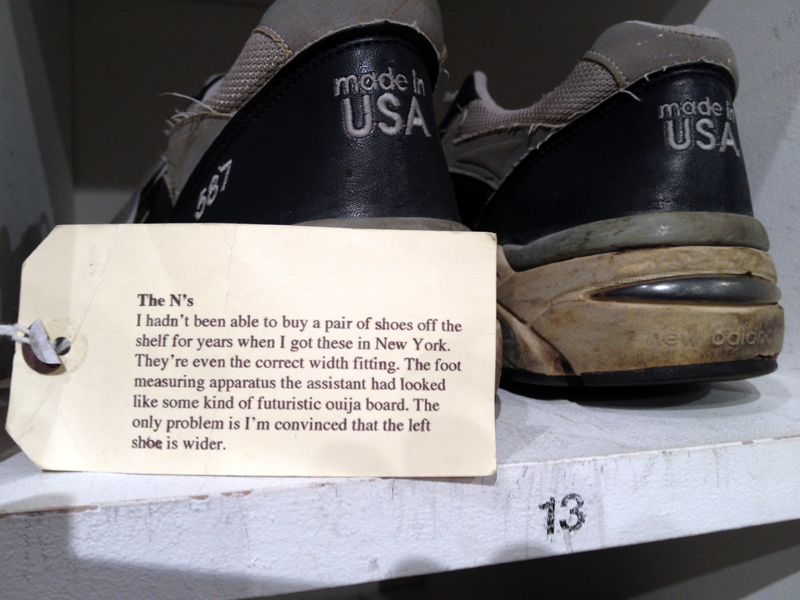
He provides anecdotes about each pair:

Other artists exhibiting include: David Batchelor, Steve Bishop, Matthew Darbyshire, Tessa Farmer, Guerra de la Paz, and Bedwyr Williams. The show continues until 26 August, and is well worth a visit if you are in the area.