Archive

Graphic Design

This week I published number 1000 image of McJunk to Flickr. This is a noteworthy occasion, because at the publication of the McJunk photo book in January 2011, I had only just uploaded 500 images. Therefore, in less than one and a half years, I’ve doubled the number of photographs of McDonald’s litter it had previously taken me 9 years to collect. It is difficult to tell whether this is because there is more McJunk out there, or because since the publication of the book, I’ve been more proactive in capturing examples I happen upon.

Whatever the reason, I’ve decided to take a hiatus from McJunk to concentrate my spare time on some other project ideas I’ve been scribbling in notebooks recently. To mark this breathing space, I’ve decided to publicly publish the essay I wrote to accompany the book. I will continue to take submissions to the McJunk project and post them to Tumblr, and the book will still be available—see the McJunk website for details. The McFacebook page will, likewise, continue. And if you are interested in seeing what 1000 piece of McDonald’s litter looks like, please visit the Flickr set.

The essay can be downloaded from the Dubdog Archive page

McJunk number 1000

I’m currently putting together a lecture titled ‘What is a book?’ for a sixth form higher education taster day I’m involved in at UCS next week. In the process of my research, I came across this excellent video of Irma Boom talking about her work, which I had never seen before. Unfortunately it is a little too long to include in my lecture, so I thought I would share it here. It is worth 6 minutes of your time.

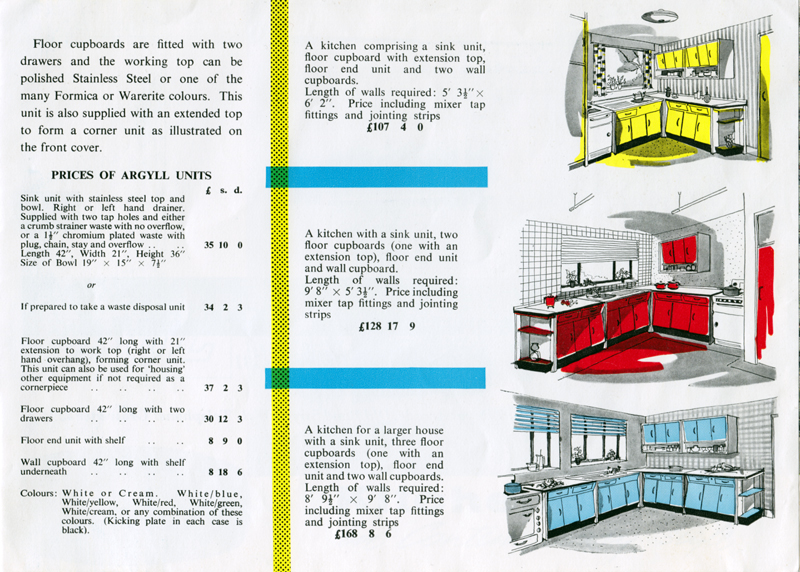
When Claire and I decided to rip out our old, dark wood fitted kitchen, over 10 years ago, it coincided with my Mum becoming an executor for an old family friend who had died. In being charged with clearing their bungalow in Clacton, my Mum didn’t know what to do with the stainless steel Paul kitchen units they had. As she pondered taking them to the local dump, Claire and I shouted, “we’ll have them”, and they’ve stood in our kitchen ever since. However, this post isn’t about how incredibly lucky we were to get hold of these domestic beauties, but about the brochures that came with them, for Fred, the family friend who had passed away, kept all paperwork for everything he had ever bought. As my Mum went through some of this immense amount of paperwork, she came across some wonderful brochures for the W. H. Paul kitchen units that he must have ordered before deciding to make a purchase. I found them again a couple of weeks ago, and thought I would share these relics of a time gone by. As brochures for such items become less and less common, largely due, I guess, to the Internet, and any that are still produced tend to have much less personality than these Mad Men-esque historical documents, they become a fascinating view on early 1960s domestic aspirations.

Below, the cover of one of the many brochures obtained before Fred decided on which units to go for:

The illustrations in this brochure are fantastic, and the graphic devices of blue rectangles and dotted yellow strips to break up the information on the page are evocative of early 1960s layout, pre-modernisms’ Helvetica & photography driven homogeneity, they fashionably signal that these items are desirable and contemporary statement pieces.

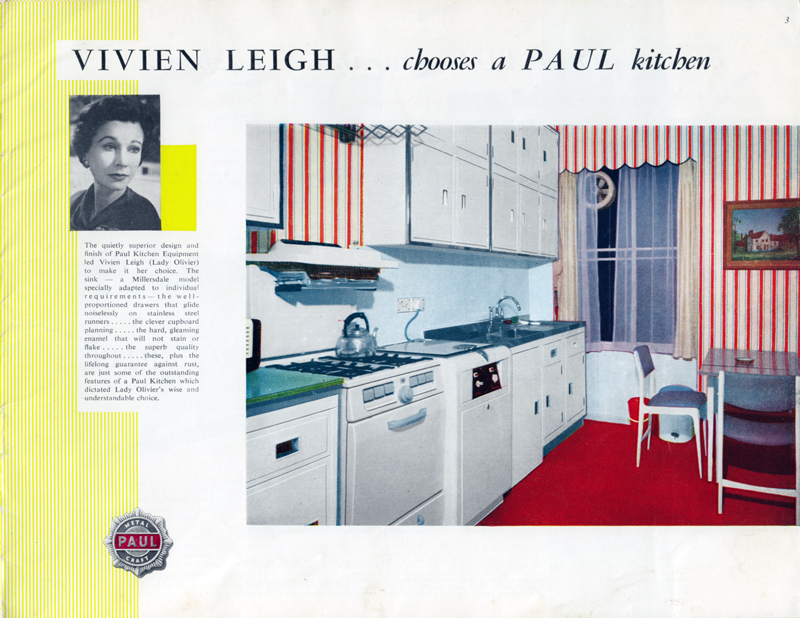
Celebrity endorsement isn’t just a recent phenomenon, as Vivien Leigh professes her love of a Paul kitchen.

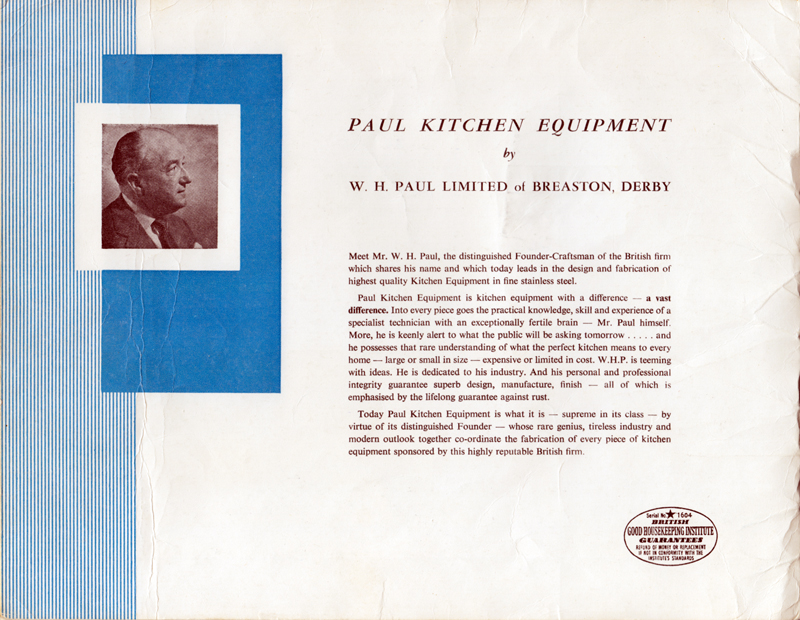
Meet Mr W. H. Paul…

Plan your kitchen layout:


Brochure cover with metal ‘Metal Craft’ Paul logo attached.

Unfortunately the sink unit we got didn’t have this ‘secret’ Wash Wonder component.

Other Paul wonders available, the Warma and Warmette.

Looking somewhat different to the illustrations and photographs in the brochures; the sink unit in our kitchen. I wonder whether Vivien Leigh would approve?

The accompanying letters found with these brochures tell that Fred bought the units in 1961, directly from W. H. Paul Limited, in Breaston, Derby. 52 years later, the brochure claims are as good as their word, and there isn’t a trace of rust on any of them. This is lucky for us, as a quick search on Google doesn’t seem to tell whether W. H. Paul are still in business, so we may have had trouble claiming against the lifetime guarantee if there was a trace of rust on them.

It has been a bit of John Peel fortnight. Firstly, I got a call from a Shelia Ravenscroft regarding some tickets I had inquired about weeks ago. As the gig I wanted to go to had sold out in a matter of days, I had forgotten that I had left my number with the box office. On snapping up the tickets that had suddenly been found, and putting the phone down, Claire informed me that Shelia was in fact The Pig, as John Peel affectionately referred to his wife when broadcasting.

The tickets were to see Billy Bragg play Woody Guthrie songs at the newly formed John Peel Centre for Creative Arts in Stowmarket. It was a great evening, and as much a lecture about the life and times of Woody Guthrie as it was a concert. Bragg was in fine voice, and having seen him perform three time in the last 3 years, twice within a year, I can definitely state he is a better performer under a Tory government than he was under Gordon Brown’s administration. John Peel would have loved it.

The Centre itself holds a lot of promise. Still in development, the old Corn Exchange has only recently had accessible toilets plumbed in. As the Centre’s committee raise more money, they plan to put in a mezzanine floor for a cafe and rehearsal space for local bands, which will also help to improve the acoustics, as the roof is somewhat cavernous, albeit beautifully so.

My second brush with the man came when the archiving of John Peel’s record collection was announced. Initially focussing on vinyl LPs, this excited me no end, (despite meaning that the 7″ single I feature on that he played on his evening show in 1992 won’t be included). The mammoth task of alphabetically uploading 100 albums a week is a daunting one and I’m amazed they did all the ‘A’s in one go, expecting there to be more in his collection. However, it looks like the ‘B’s may take a little longer.

Disappointingly, the only tracks you can listen to are linked to Spotify, meaning that if you were hoping to hear again some obscure German techno artist you first heard on a Tuesday evening in 2001, you will probably be sorely disappointed. More exciting though, from the perspective of graphic design, is that all album artwork has been scanned, including inner sleeves. Unfortunately there isn’t a zoom function, which is frustrating, and the site works better on a desktop computer than on an iPad, but I feel churlish to complain too much considering that this historic document wouldn’t otherwise be accessible in any format.

My one big grumble though, is that the release dates of each disc aren’t featured.

For anyone who listened to John Peel’s late night shows, (or for a period in the 90s, his Saturday afternoon show), this will prove to be an enticing trip down memory lane. And as if to prove the point, David Stubbs’ trawl through the first 100 records in the collection, along with YouTube clips, is well worth a read over on Quietus.

And lastly, my final brush with Peel this week was on visiting some friends last night who were listening to Tom Ravencroft’s 6music show, on iPlayer, meaning it was one week old. It is kind of odd hearing old news repeated as if it were just breaking, especially the announcement of Adam Yauch’s death at regular intervals. I didn’t find out about Yauch’s death when it was announced last Friday evening, because that was when I was at the John Peel Centre listening to Billy Bragg. So last night I witnessed John Peel’s son, who’s voice and intonation spookily sound like that of his father’s, announcing the death of someone from a week ago, when I had actually been at his Dad’s legacy with his mother in the audience!

Strange, talk about augmented reality.

The Comic Sans dropping through my letter box appears to have eased for the time being, only to be replaced by gradients! All in aid of some woman’s diamond jubilee, and my neighbours trying to convince me to attend a street party in her honour via the medium of Word Art on A4. There’s going to be hog roast, a band, a 60s–80s discotheque, and people are being encouraged to wear red, white and blue!

As a republican and a graphic designer, I’m not sure what I object to most, the noxious event happening across the street from where I live, or the crap graphics coming through my letterbox! If this was only to be an afternoon event, then I could just make sure I take the dog out for a very long walk. However, as this is obviously going to be going on well into the evening—and knowing some of my neighbours, the small hours of the night—then I’m not sure I won’t do something rash. Maybe I should start believing in an interventionist god, then I can at least pray for rain.

In reading Fiona MacCarthy’s overview of Bauhaus—the German design school, not the 1980s goth band—in yesterday’s Guardian, several thoughts came to mind, but none more so than that of the blinkered nature of design history. The premise of the article, written prior to the opening of the Bauhaus: Art as Life exhibition coming to the Barbican in May, is best summed up by its closing paragraph where MacCarthy states: “The Bauhaus revival could not be more timely. In a world in which idealism in design and architecture is in short supply, it is good to be reminded of this bold and beautiful experiment in bringing creativity alive.”

Well, it could be (wrongly) argued there is a lack of idealism in society in general, and on the surface of it, I agree, there doesn’t appear to be much idealism in design at the moment. However, that is on the surface. If you dig a little deeper, there are plenty of critical design thinkers and practitioners out there, just as there always have been. Unfortunately, they don’t get given enough media coverage outside of Eye magazine and design blogs for their thoughts and work to be taken note of.

Leaving talk of radicals such as Occupy Design to one side for the purposes of this post, one group of designers that I’ve been following recently that I believe do show an idealistic streak has been Government Digital Services (GDS). I first took notice while following Ben Terrett’s Noisy Decent Graphics blog. Terrett recently left Wieden+Kennedy, an advertising agency, to become head of design for GDS, a Government department looking at how digital services are delivered, and in no small way has announced that the GDS remit is as big as that of Margaret Calvert and Jock Kinnear, the designers that transformed the road signage system in the UK in 1950s. Terrett says: “Before they [Kinnear and Calvert] came along Britain was littered with different signage systems all using different symbols, colours and typefaces which was at best confusing and at worst dangerous. With an exponential increase in vehicle traffic the government knew something had to be done. Kinnear and Calvert proposed one consistent system. One designed with the clarity of information as it’s goal. From then on Britain had a solution that became the definitive standard and was copied around the world.” Bringing us back to 2012, Terrett goes on the state: “Sound familiar? Swap signage systems for websites. Swap vehicle traffic for online traffic.” Anyone who has used the navigation nightmare that is Directgov should be able to sympathise with this analogy.
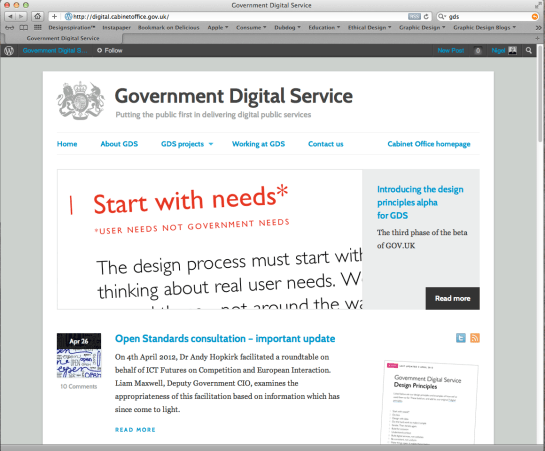
So, what are GDS doing? Well, firstly, they have set up a blog that details what they are up to. You can sign up for regular email updates that informs you of key developments, discussions and advances in their work. This, in itself, is fascinating, regardless of what they are doing, as you can witness the design process in action, which is extremely rare. One recent post discussed how the homeless access, and can make use of, digital services. This is an important consideration as more and more content is becoming embedded in online delivery, with fewer chances to access services through traditional methods. Therefore, how do those that are marginalised in our society get at what they need when they have limited means to be able to do so? These are important and interesting contemporary debates. But further to just being passive observers of this process of research and development, you, the person receiving the updates, are encouraged to give GDS feedback and get involved in the discussion, and therefore the process.
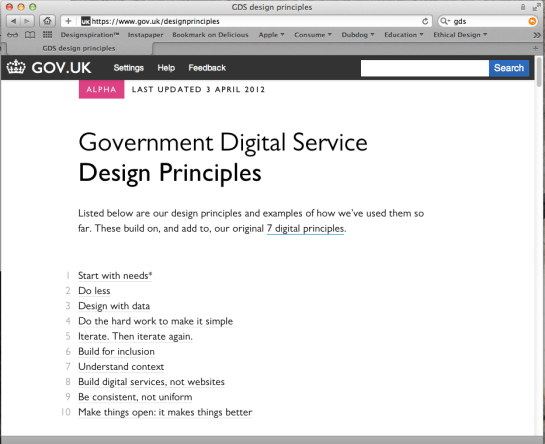
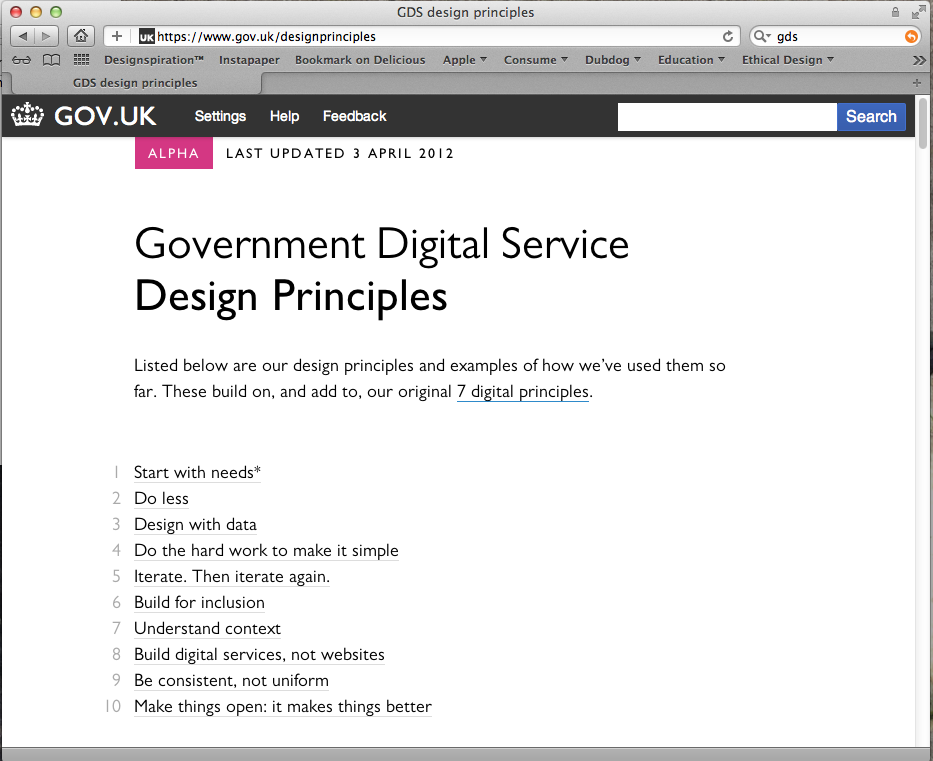
GDS have also put their thoughts and design beliefs centre stage of what they are doing by publishing a set of Design Principles. This manifesto has ideals at its core, ideals for making Government delivered digital services work for the end user; efficiently, transparently, functionally. Practicing Form Follows Function, the Bauhaus masters would be pleased.

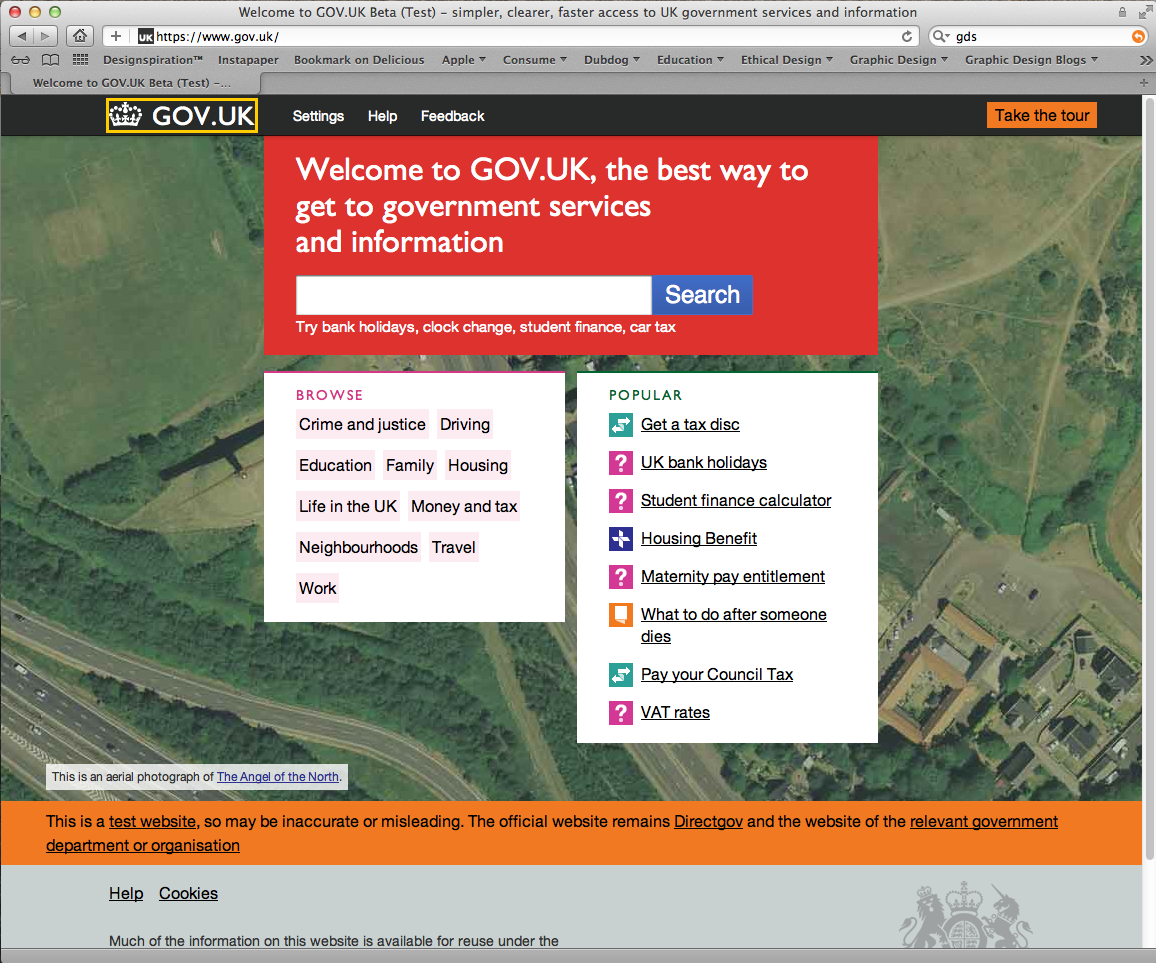
Other than a blog, the big plan for GDS is to replace Directgov with Gov.uk. To advance this, GDS have set up a beta site for anyone to tryout and feedback to them. It puts cookies and a search engine at the heart of its operation, to make it as efficient as possible. The wider the demographic, and people with differing digital competencies, that trail this, the better. Only skewed results will come from design and Internet savvy audiences—so if your granny doesn’t go online much, get her to use it and give some feedback. And even if you can’t be bothered to give feedback, just by using the site, you will automatically be feeding back by your actions, as one of the GDS design principles is to design with data.

This is an exciting design led project, especially one that could be considered for such potentailly dry subject matter. So, while I’m on the verge of booking my tickets for the Bauhaus exhibition, I don’t believe we can afford to write off idealism in design because we only relate it to a specific timeframe seen through the blinkers of design history teaching. Today, tomorrow, yesterday; all are equally important if we want to engage people with design and further any discussion about its importance to society. However, the trouble with design history and its attempts to engage non-designers is that it is far too often stuck in the past.

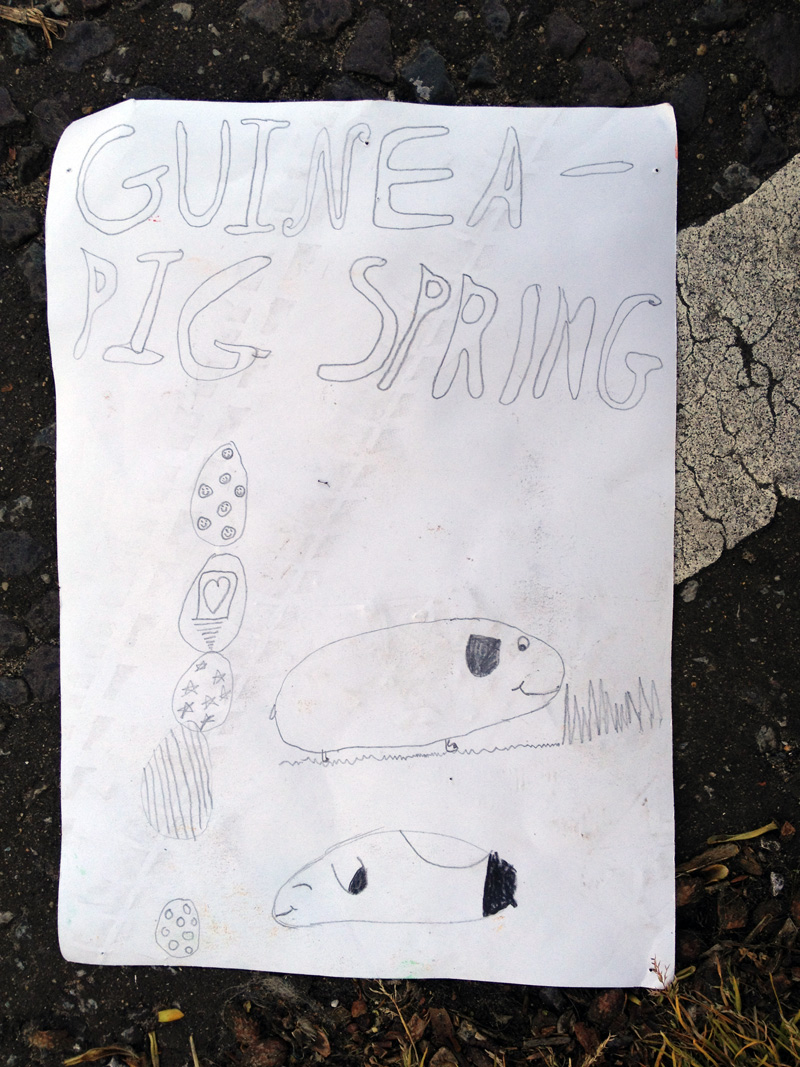
I found this in the street on the way home tonight. Is this the work of a future graphic designer? And is this championing some sort of rodent uprising I was unaware of?


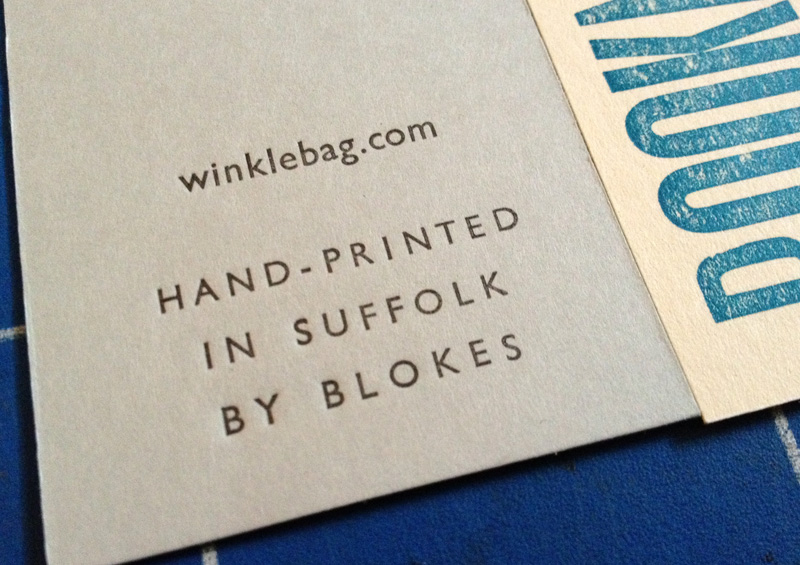
A big thank you to Michael Dobney for showing Claire and I round the rather wonderful Winklebag this Sunday, a very small letterpress set up in the heart of beautiful Suffolk countryside.

After reading a post I wrote here a while ago about a ‘printing for all’ workshop at the Museum of East Anglian Life, where he also volunteers, Michael got in touch and invited us out for a visit.

Winklebag is a rather inspiring set up, particularly for an ex-printer like myself, and I am now itching to conjure up a job I can put through there. Watch out anyone who commissions Dubdog in the near future, you could be going down an inky route.

It was doubly interesting to see a small tabletop Adana press, which I’ve been reading a lot about recently for my archive blog of old print and type advice books: The Small Letter. Below is an illustration of the Adana “Eight–Five” from the “Beginners Guide to Design in Printing” by Leslie G. Luker, (an Adana publication, as many of them seem to be).

Once again, many thanks to Michael for his time, coffee and chat. Check out Winklebag’s website here.