Earlier last month few could have escaped the surprise announcement of a new David Bowie album, scheduled for a March release, titled The Next Day.

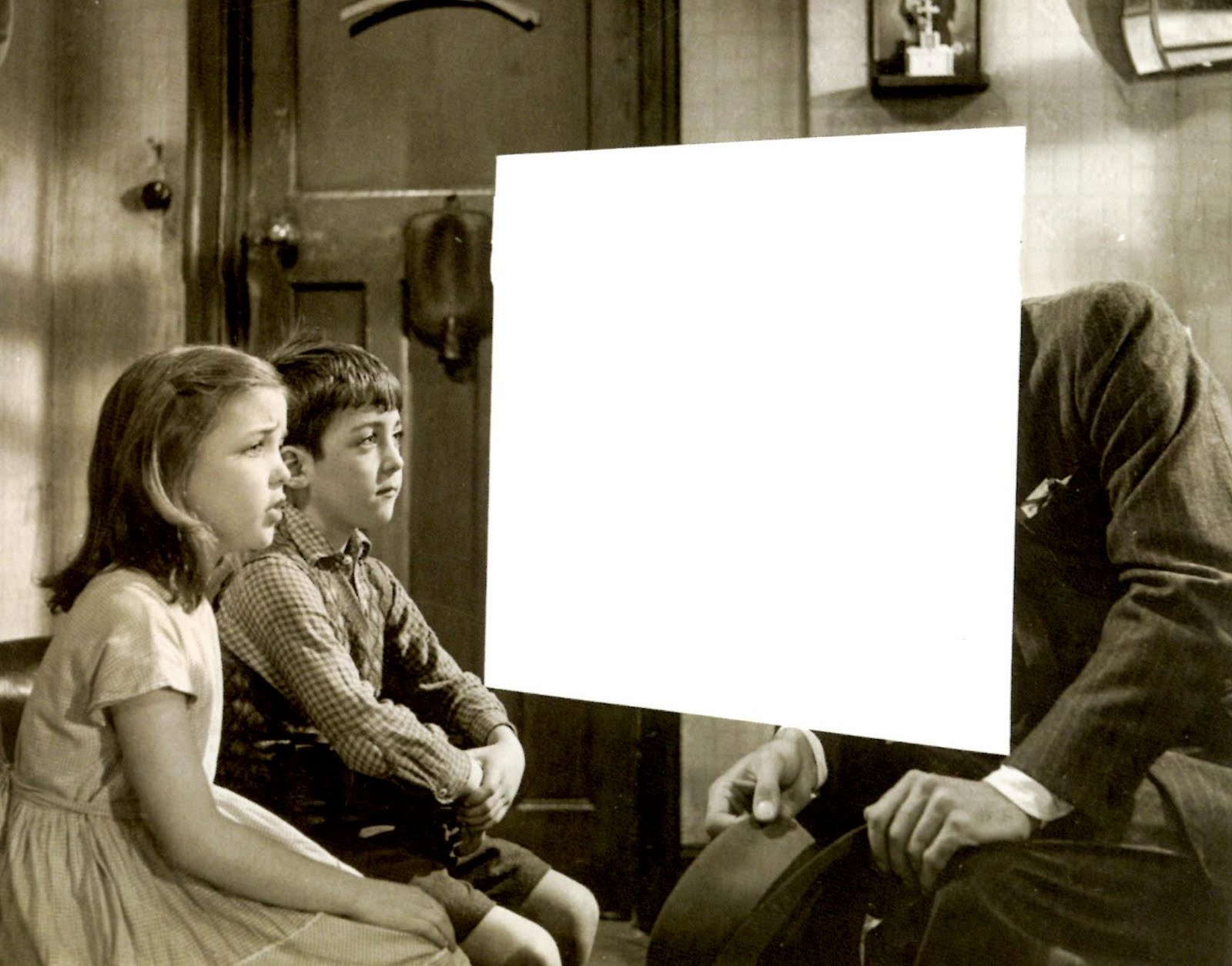
The artwork dropped with almost as much of a shock, to some, as the album. The artwork places a white square over the original iconic cover of “Heroes”, Bowie’s 1977 collaboration with Brian Eno which is considered by many as one of his best works. While this was sacrilege to some, others, along with myself, thought it a brave masterstroke by Jonathan Barnbrook, who has worked with David Bowie for the last 10 years.

newheroes_0

David Bowie – The Next Day. Sleeve by Jonathan Barnbrook, 2013

On seeing Barnbrook’s work for Bowie, I immediately drew associations between The Next Day sleeve and a new jacket for George Orwell’s Nineteen Eighty Four by David Pearson that was showcased on the Creative Review blog shortly before the announcement of the Bowie album. Here, Pearson obliterates the title and author of the book to reflect the redacting of history in this classic Orwellian tale.

nineteeneightyfourdropshadow569_0

George Orwell – Nineteen Eighty Four, cover by David Pearson, 2013

Naturally enough though, I wasn’t the only person to make such a comparison as Richard Weston’s Ace Jet 170 blog testifies. And there, my thoughts would have rested, beaten in the blogosphere to writing a post about the Bowie/Orwell connection.

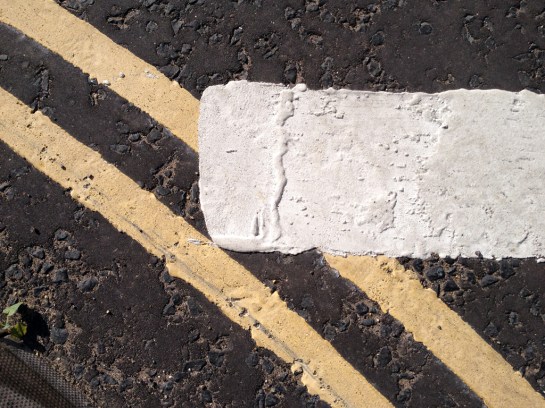
However, I then got thinking about these two pieces of work and their deliberate graphic obscuring—where one piece of communication has been interrupted by another to create a new work that forces the viewer to question what they are reading—and how this related to things I’d been observing in my everyday. For a little while now I’d been noticing such occurances as road markings being obliterated by the visual remains of where road works had taken place, their primary communication scarred and temporarily interrupted; or where different street signs had been overlaid partially obscuring aspects of one or both.

IMG_2967

JacobsWay

These observations have started to inform a new photographic project of mine, (working title Graphic Interruptions), which currently only consists of some test pieces posted to Flickr. The obvious differences here are that Barnbrook’s and Pearson’s work both deliberately interrupt one visual device with another to form a new narrative, where as what I had been looking at were mostly accidental. I don’t quite know yet where this project is going, but I’m finding it visually intriguing.

But then this visual intrigue was whetted again this week when I succumbed to buying the John Stezaker monograph, which I had been coveting for some time. The book was published in 2011 to accompany his exhibition at the Whitechapel Gallery the same year. Unfortunately I missed the show, but was bowled over by the images that were shown alongside many of the rave reviews in newspapers and on blogs at the time. Could it be that this work, first seen a couple of years ago, had stayed with me and fed my visual thinking when walking around and noticing my graphic interruptions?

StezakerMaskIV 2005

John Stezaker, Mask IV, 2005

Mask IV is typical of the collage work that attracted me to Stezaker. At first, I didn’t make an immediate connection between all of the above and the influence Stezaker’s show, directly or indirectly, has potentially had on my thoughts about what the book calls ‘occlusion’, (the art of blocking).  But I am beginning to now.

And then, looking through the book, I came across two images that made me wonder whether Stezaker’s work had also influenced, consciously or otherwise, Barnbrook’s The Next Day sleeve:

StezakerTabula RasaXI2008

John Stezaker, Tabula Rasa XI, 2008

John Stezaker, Tabula Rasa II 1983

John Stezaker, Tabula Rasa II, 1983

With or without placing ‘The Next Day’ text in the white rectangle, you can easily see the connection between this and the sleeve of the anticipated David Bowie record.

My observations here are purely that, observations. I’m drawing together recent thoughts that may or may not have fed into each other, but that do spark a line of questioning regarding the narrative of an image. This might just become my 2013 obsession.

IMG_1052

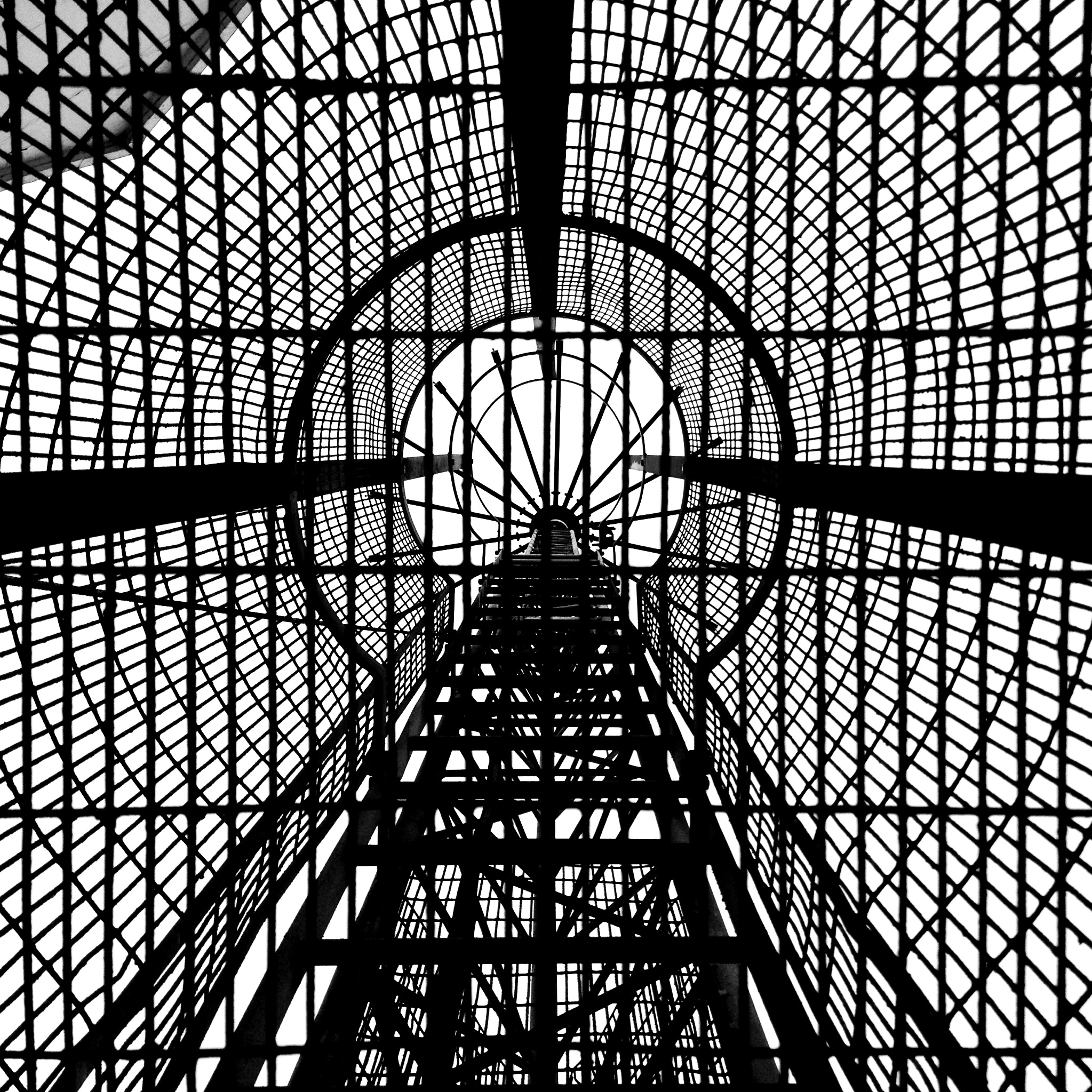
Coastguard mast seen from the ground, Shingle Street, Suffolk

I’ve recently rejoined Instagram. My departure in December 2012 was, like many others, due to the announcement that Instagram was going to change their terms and conditions that would allow them to let advertisers use my content without asking. Instagram soon backtracked on this, but I had made the break. At the time I was considering leaving anyway, as I had started to question how many social networking sites I was on, and what I was getting out of them. So this minor media blow-up prompted my exit, and as such, I wasn’t bothered about rejoining once the back peddling started.

However, much to my surprise, I actually found that I missed it.

Around the same time, many photographers I know started getting quite vitriolic about people who use Instagram, and posted articles on their Facebook walls against the photo sharing app. One such was by Jonathan Jones in The Guardian, which pretty much calls anyone who uses Instagram mindlessly deluded. Now, if there is one thing that winds me up more than anything else, it is artistic elitism—so I rejoined Instagram, if for nothing more than to wind up people with such attitudes.

To be honest, I was a little incensed by such opinions, and so some furious notebook scribbling has resulted in the following points, presented here for your reading pleasure:

  • Anyone who is so vehemently opposed to something usually feels threatened by it, and this usually results in a defensive attitude. This is what I believe we are seeing here. Anything that looks popular is immediately denounced and elitist walls start rising, soon to be followed by over blown pompous statements and incredulous derisions that do not really have an ounce of an objective rationale.
  • Photographers do not own photography. It is a popular activity, for anyone to take part in for their own purposes. In fact, anyone who owns a camera is automatically a photographer, and therefore has as much right to do what they want within the medium as anyone else. For good or for bad.
  • I do not disagree that much on Instagram is vacuous and of little artistic merit. Particularly the filters, which I use sparingly and only to enhance a poor photograph. But that doesn’t damn the medium. A good analogy is with that of looking at Punk music between1976–79. Immediate and of the people, Punk encouraged anyone to pick up a guitar and get involved. This was both its beauty and its downfall, as a thousand god awful bands formed. But a few fantastic talents emerged that wouldn’t have otherwise, and they developed and grew to be of great importance to the wider world of music. So to with Instagram—it is there, free to download if you are lucky enough to be able to afford a smart phone, and there is stuff of value there if you choose wisely in who you follow.
  • Many of the people I follow are designers. There is something about its immediacy and ‘of the now’ nature that is appealing in sharing with people who have a particular visual outlook on their surroundings. As well as locations I am unlikely to see, typography, book jackets found in flea markets and architectural points of interest, to name a few subject matters that occur regularly, are visual thoughts knocked backwards and forwards between followers. To be able to check this in the middle of a mundane day is not just to feel connected, but it encourages the viewer to look at their own everyday from a different perspective.
  • Instagram is by far a better designed interactive mobile image sharing vehicle than Tumblr, which, in and of itself, tends to encourage the sharing of other people’s work with little to no respect for copyright. (No offence Tumblr, you have your purpose and are good at it).
  • There is just as much vacuous art photography outside of Instagram as there is engaging and intelligent work. Shit photography is not the preserve of Instagram, and photographers have no high-horse to get on from this perspective.
  • And finally, the concept that something can only be validated if it is on a gallery wall is beyond ridicule.

I use Instagram as a visual scrapbook for my on-the-go visual notes and thoughts, albeit a scrapbook that I welcome others to share in. I do not want to see photographs of other people’s meals or kids or snowmen with or without a wacky filter; so I don’t follow those that post such things. But I do want to see the photos of, say, Dan Hill, the architect, designer, writer and CEO of communication research centre Fabrica , whose City of Sound blog is always a stimulating and intelligent read and who has much to say on all things design related. To see the the experiences and interests behind what informs his opinions and his writing is always engaging, and never ever deluded.

My first article for Eye magazine’s blog was published today. It is available to read here.

Screen Shot 2013-01-25 at 17.08.10

A new year, a new page on the Dubdog blog.

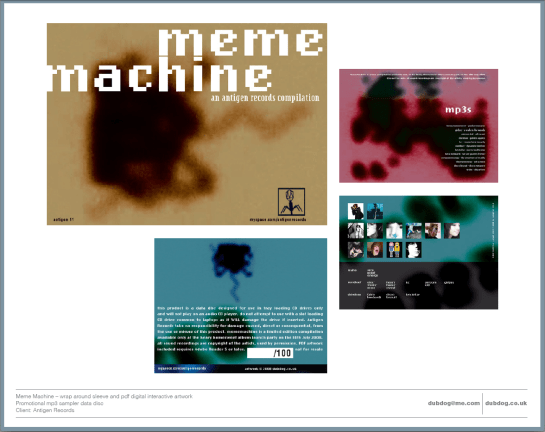
Looking at the menu above, regular visitors here will notice a new page titled Work has suddenly appeared. Since I moved from Blogger to WordPress early in 2012, I have been meaning to create a section on this site to showcase some of my creative output, and have finally gotten round to making one. This was largely prompted as I’ve recently had to create a portfolio pdf for an application, (more news on this later), which will hopefully lead to some exciting news, (for me at least), later in the year.

Screen Shot 2013-01-04 at 14.09.29

The portfolio showcases a range of work created over the last 10 years, and includes both commissions and self-set projects and its aim is to demonstrate as wide an approach to visual communication as possible. It was difficult to decide what went in and what was left out, and those familiar with my long standing portfolio site that I shut down in 2010 will recognise some of the work.

Having this facility here also allows me to add other content for visitors to download, such as my McJunk essay and presentation presentation slides. This is particularly useful for those that balk at the ever increasing costs of Blurb books and who can’t afford to purchase a copy of McJunk.

While I’m discussing the four letter word that is work, 2013 is starting to look like a creative year for Dubdog, which will be a challenge to fit in alongside the full-time day job, but should be rewarding none-the-less. I’ve been approached to do some design work for a renowned fine art photographer, and the next issue of the UCS academic journal, Childhood Remixed, is being published at the end of February, so I will be busy designing that from late January onwards.

As well as the above, I also have a couple of photographic projects up my sleeve. One, called Graphic Interruptions, has already started seeing the light of day on Flickr, where I’m investigating instances of  where graphic content collides, is interrupted by, or clashes with natural or man-made forms. Much like McJunk, I’m unsure of where this is going as yet, and as a project it is in its infancy, but none-the-less I finding it visually intriguing. Alongside this is another photographic project which is still in the testing phase, and may or may not be mentioned again, depending on initial results.

IMG_3061

Thanks to all the readers who have stopped by here in the last year, and I look forward to your company again throughout 2013.

And so to the annual round up of what I’ve been listening to over the last 12 months. There have been some real disappointments in 2012, (Animal Collective, The XX, Julian Cope; to name a few), and there has been nothing completely ‘new’ that has knocked me for six. Death Grips came close, but I’m convinced that was as much to do with the hype as anything else. A storm in a teacup me thinks, albeit one that is almost the perfect accompaniment to a dying music industry.

This year I discovered some old music that did excite me though. The first up was Can, which considering my post-punk tastes, is surprising that I hadn’t listened to them before, taking into account how influential they were to many of the innovative bands that came immediately after the Sex Pistols et al. I heard a Can track on the radio early in January, I can’t remember which song it was, and it blew me away. Was this really the same band that I had passed off as a bunch of hippies in my teens? (Although now I think about it, I may have got them mixed up with Gong back then). I immediately trawled iTunes, and after listening to various tracks and reading several reviews, plumped to download ‘Tago Mago’. I couldn’t believe that I had previously dismissed this band. And when ‘The Lost Tapes’ came out in Spring—unearthed recordings that (mostly) hadn’t seen the light of day—I snapped it up. This release, without a shadow of a doubt, is easily my favourite record of 2012.

A similar experience happened when I discovered Brian Eno’s early work this year. Obviously I knew Roxy Music, and of Eno’s work with Bowie and Talking Heads. I also own several of his more recent ambient releases. However, I knew nothing of his first few solo albums until Mark Riley played ‘Needles In A Camel’s Eye’ from ‘Here Comes The Warm Jets’ on 6music. Why had I not heard this until I reached my 44th year? How could that happen? Needless to say I quickly bought ‘Warm Jets’, ‘Taking Tiger Mountain By Strategy’, and later in the year, ‘Before And After Science’. Thanks Mark.

Discovering pre-Midge Ure Ultravox was a pleasant surprise as well, after a friend did me a copy of ‘Ha! Ha! Ha!’ Considering that all I knew of them was the 1980s pomp they produced when I was in my teens, and automatically hated, this was a revelation and got me questioning how many other bands have shamed their preceding history by their later output? While I never thought I had heard it all, I was surprised to discover so much old music that was so good this year, which means there is potentially lots more out there waiting to be discovered. This, in itself, is probably the single most exciting thought I’ve had about music in recent years.

There have been some good re-releases and compilations this year which, keeping on the old music theme, kept me going considering the brevity of exciting new material. Keith Hudson’s ‘Rasta Communication’, The Beat’s first two albums, various Lee ‘Scratch’ Perry and Joe Gibbs compilations have kept the Dubdog happy. Rediscoveries included The Fall’s I Am Kurious Oranj, which proved not to be as good as I remember it being first time around, The Stranglers’ ‘The Raven’, which did prove to be as good as the first time around, if not better; and Crass’s ’10 Notes On A Summer’s Day’ was rewarding in a way it wasn’t first time around.

As for new music, it is always good to hear the strained tones of Mark Stewart, regardless of the quality of the music that is backing him. Burial has continued to be interesting, and DELS released an EP at the end of the year which makes his album due in 2013 one to be on the watch list. The Mogwai and Björk remix albums were different enough from their originals to be included in this list, and both had some great moments. The first half of The Pre New’s ‘Music For People Who Hate Themselves’ got repeat playings when it was first released, particularly while driving, but David Byrne and St Vincent’s brass band experiment proved ultimately too much across an entire album for me, which means as a whole, I haven’t really given it the time of day such a work probably deserves. Godspeed and The Swans returned, literally with (musical) vengeance, and I never thought I would ever listen to Neneh Cherry again in my life, but her work with jazz trio The Thing is inspired, particularly their take on The Stooges ‘Dirt’. And lastly, two albums distinctly different from each other that I couldn’t help returning to over and over again, were Chairlift’s ‘Something’, which reminded me of Pauline Murray and The Invisible Girls first album, (sadly not available digitally); and Wrongtom and Deemus J’s ‘In East London’, which careers over pretty much every dancehall and reggae sub-style you can imagine, and is all the more enjoyable for it.

So that’s my recorded year. Live, edited highlights include The Ex with Brass Unbound who were phenomenal, (as was the whole evening they curated at Cafe OTO early in December). Liars bought WIXIW to life in Norwich and are now on my list of bands to go out of my way to see when ever they tour the UK again. King Creosote and Jon Hopkins gave a very special and atmospheric performance of Diamond Mine, again, in Norwich. Other folk included Billy Bragg playing Woody Guthrie at the John Peel Centre in Stowmarket, and the instrumental Spiro at the newly formed Folk East Festival were excellent with their post-rock take on folk music, (my pretentious description). Nathaniel Robin Mann was incredible not once, but twice in Ipswich and at Folk East—check him out, there’s plenty on YouTube, you will NOT be disappointed. However, I can’t complete the list without mentioning how much fun it was seeing Adam Ant play in Ipswich. He’s not someone I would have travelled far to see, but as ‘Dirk Wears White Sox’ is a favourite album of mine, I felt obliged as he was only down the road. The set predominantly featured punk-Ants material, which worked surprisingly well after all these years and kept me happy, and the enthusiasm among the packed crowd for the pop-Ants tracks was infectious. However, as tempting as it was, I managed to resist doing the Prince Charming dance.

The List

The Conversation (The Original Soundtrack) – David Shire
Lee “Scratch” Perry – Nu Sound & Version
Gold Panda – DJ-Kicks
Guided By Voices – Let’s Go Eat The Factory
Can – Tago Mago (40th Anniversary Edition)
Ultravox! – Ha!-Ha!-Ha!
Josh T. Pearson – Last Of The Country Gentlemen
Chailift – Something
Gonjasufi – Mu.Zz.Le
Yannis Kyriakides & Andy Moor – Rebetika
Brian Eno – Here Come The Warm Jets
Django Django – Django Django
Leonard Cohen – Old Ideas
Agnostic Mountain Gospel Choir – Ten Thousand
MGMT – Congratulations
Various – The Wire Trapper 26 (Edit)
Dub Colossus – Dub Me Tender Vol 1 & 2
Brian Eno – Taking Tiger Mountain by Strategy
Barry Adamson – I Will Set You Free
DJ Food – The Search Engine
Portico Quartet – Portico Quartet
Burial – Kindred EP
The Stranglers – The Raven
Field Music – Plumb
Electricity In Our Homes – Dear Shareholder
R.U.T.A – Gore
Paul Weller – Sonik Kicks
The Fall – I Am Kurious Oranj
Mark Stewart – The Politics Of Envy
Spiro – Kaleidophonica
Trembling Bells and Bonnie ‘Prince’ Billy – The Marble Downs
Joe Gibbs – Scorchers from the Early Years (1967–1973)
Joe Gibbs – Scorchers from the Mighty Two
The Pre New – Music For People Who Hate Themselves
Death Grips – The Money Store
Public Image Ltd. – One Drop EP
Public Image Ltd. – This Is PiL
Dubwood Allstars – Underdubwood
Various – Ska-ing West
Various – Mento & RnB
The Beat – I Just Can’t Stop It (Deluxe re-release)
The Beat – Wha’ppan (Deluxe re-release)
Liars – W I X I W
Various – Wire Tapper 29
Crass – 10 Notes On A Summers Day
Julian Cope – Psychedelic Revolution
Nathaniel Robin Mann – Animateddog’s Scraps 2: The Gathered Flecks Of Hope And Sorrow
Robert Wyatt – Nothing Can Stop Us
Beak> – >>
Dead Rat Orchestra – The Guga Hunters of Ness
Dirty Projectors – Swing Lo Magellan
Can – The Lost Tapes
Can – Monster Movie/Delay 1968
The Ex – Joggers and Smoggers
Amadou & Mariam – Folila
Micachu and The Shapes – Never
The Ex – Dignity Of Labour
The Fall – This Nation’s Saving Grace
Gallon Drunk – The Road Gets Darker From Here
Various – Deep Roots Observer Style
Matthew Dear – Beams
Four Tet – Pink
Adrian Sherwood – Survival & Resistance
The Raincoats – Moving
David Byrne & St. Vincent – Love This Giant
Animal Collective – Centipede Hz
The xx – Coexist
Getatchew Mekuria + The Ex + Friends – Y’Anbessaw Tezeta
Jack Lewis and Awkward Energy – Lvov Swims The Williamette
Brian Eno – Before and After Science
Death Grips – No Love Deep Web
The Swans – The Seer
The Mountain Goats – Transcendental Youth
Godspeed You! Black Emperor – Allelujah! Don’t Bend! Ascend!
Keith Hudson – Rasta Communication
Wrongtom Meets Deemas J – In East London
Neneh Cherry and The Thing – The Cherry Thing
Bo Ningen – Line The Wall
Esbjörn Svensson Trio – 301
Lee ‘Scratch’ Perry and Friends – Disco Devil: The Jamaican Discomixes
Various – Reworks_: Philip Glass Remixed
Photek – Ku:Palm
Björk – Bastards
Mark Stewart – The Exorcism of Envy
Mogwai – A Wrenched Vile Lore
Scott Walker – Bish Bosch
Brian Eno – Lux
Anne-James Chaton & Andy Moor – Le Journaliste
Burial – Truant / Rough Sleeper
DELS – Black Salad EP

We had Jude Law bemoaning Michael Gove’s education plans from the Turner Prize rostrum earlier this month, and there have been a few rumblings beneath the surface from a few design professionals, not least with Neville Brody taking the presidency at D&AD earlier this year, (as mentioned here a few months ago). But generally, no one was really sticking their neck out and actually organising anything to try and counter act this government’s disastrous education policy and fighting for the future of the creative industries in this country. Well, now many design professionals have decided to club together to try and make the government see sense in not abandoning art and design education in the new Ebacc qualifications. Check out the Include Design website, sign the petition, and write to your MP.

Screen Shot 2012-12-16 at 17.04.37

On a visit to see my mother yesterday, she convinced us that we should go to a Christmas Tree exhibition in Brightlingsea Church. Not sure what to expect, and not really being a Christmassy sort of person, I was bowled over by two of the entries.

WoolWoolybully by Zoe Aldridge got my vote for adult entry.

RocketUnfortunately I didn’t record a credit for this tree, but it got my vote for the children’s entry, (although I suspect they might have had a little help).

Most other trees were more traditional in nature, and decorated with an array of usual and unusual objects. There were Lib Dem and Tory trees, sitting at opposite ends of the church, and it is a shame that no one was brave enough to turn the adult category into an Adult category, which would have been amusing.

But despite my disagreement about most things to do with Christmas, I’d be proud to have either of the above in my front room for the last week in December.

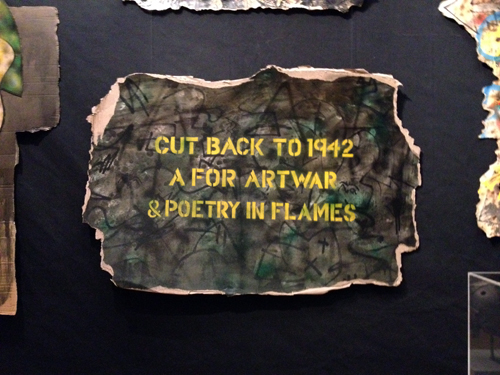
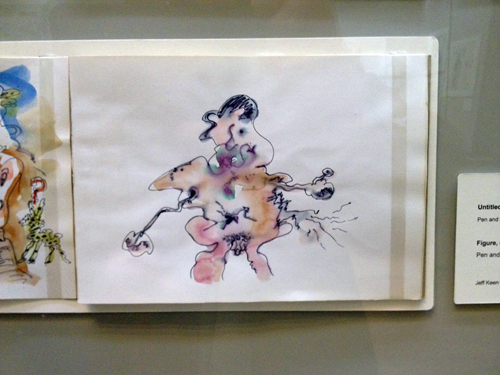
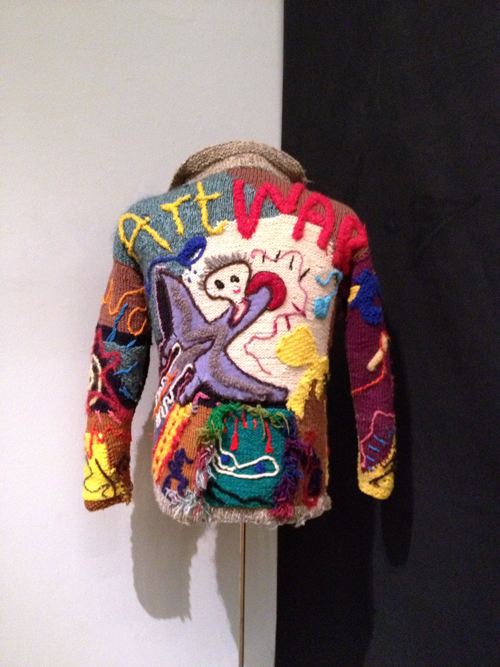
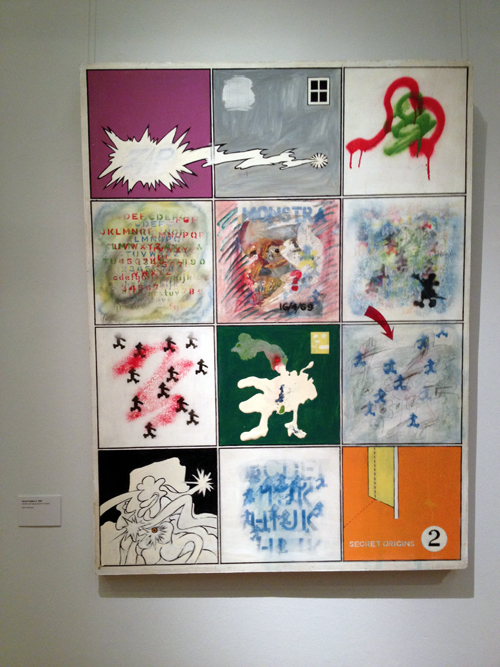
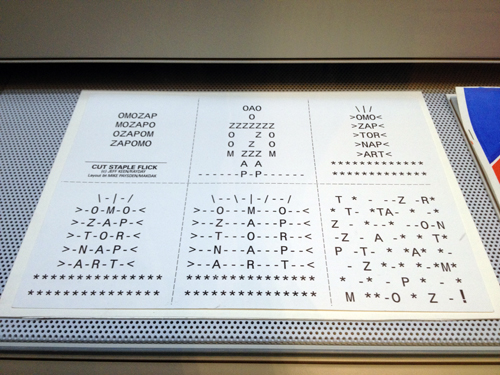
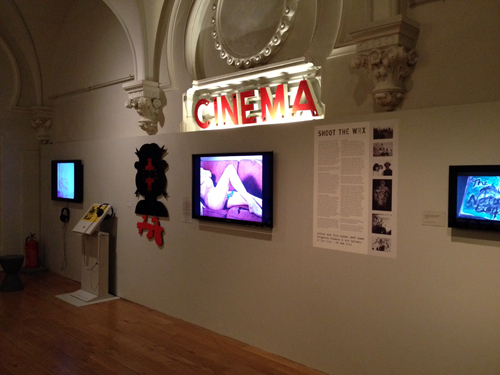
It is always rewarding to come across an artist who has previously been completely off your radar. This was the case when Claire and I stumbled across Jeff Keen’s Shoot The WRX retrospective at Brighton Museum this weekend.

It was an exciting show, with a huge variety of different styles showcased throughout his works, (or WRX, the title referencing Keen’s love of cartoon strips). Without wanting to do the exhibition a disservice, I was immediately reminded of an art foundation course end of year show—the styles were so similar to a whole host of other artists that it was difficult not to see many of the outcomes as emulation, or of someone finding their own reference points through exploring those of others. In fact, as I walked among the projections, objects, paintings and sketchbooks on display, the variety was so great it seemed incredible that all of this was the work of one person.

Listing the similarities to other artists; Keith Haring, Basquiat, Kurt Schwitters, Rauschenberg, Picasso, Terry Gilliam, Futurist poetry, punk fanzines, Anselm Kiefer, Robert Crumb…  I noted that the one unifying voice among all of this was the sense of anarchy. In fact the tag line of ARTWAR that adorns many of his pieces suitably sums up his destruction of other’s visual signatures.

The Foundation show is an unkind tag, as Keen’s edit, maturity of application, and consistent sense of chaotic narrative, would rarely been seen at such a level. And much of the work was more than the emulation often displayed in such shows—this was someone in their element, the work vibrant and playful with an underscoring attitude, as opposed to students on a stepping stone to something else.

Keen moved to Brighton in the 1950s and steadfastly refused to leave, and it is unfortunate that he died in June of this year. The energy on display is truly inspirational, and the sheer eclecticism in both medium and approach amazes because in such a show, the sum of the parts becomes the whole. By the time you get to the last film, shown on the balcony opposite the tea room in the museum, it becomes entirely logical that this is the work of one man.

The show runs until 24 February 2013 at The Brighton and Hove Museum and Art Gallery, entry is free.

Jeff Keen’s obituary—The Guardian.

I received David Byrne’s new book, How Music Works, through the post yesterday. It is a beautifully produced object. The cover is subtly padded, (as if the book itself was actually sound proofed), while the layout is sensitively understated.

Book cover for David Byrne's How Music Works

Spread from How Music Works

Byrne pulls on his vast experience as a musician to explore how technological changes in the production of music has affected music itself, looking at what it means to go on stage, and many other associated topics. Therefore, it is both part autobiographical, and, as he puts it himself, a series of ‘think pieces’.

Byrne avoids being highly technical, as well as steering clear of stories about rock star excess and redemption, it is therefore the perfect antidote to the ego massaging rockumentaries being spewed out by the BBC of late. This is not a trawl through the history of his many musical projects, although they are used as a contextual sounding board to discuss the business of music, (as opposed the the music business). As an introduction to some of the contexts discussed, and the self-effacing nature of the man himself, it is well worth watching the Ted.com talk Byrne gave in 2010, where he talks about how architecture has helped to shape the evolution of music.


Still from the fil Ride Rise Roar

Spread from How Music Works‚ (a still from the film Ride Rise Roar)

Intelligent and accessible, interesting and engaging, this book comes highly recommended.