There is much talk about The Lost Tapes by Can at the moment, and with good reason. For those reading this that know nothing about the band, or the context within which they emerged, then there is an excellent essay on Quietus by Taylor Parkes that comes with a Dubdog recommendation. However, the point of this post isn’t to talk about Can, or the fact that these lost tapes were only rediscovered recently, or the importance of the band and their music, but to discuss the artwork and packaging.

The graphic design is done by Julian House at Intro, who is no stranger to music related projects. He has worked with many bands in his time at Intro, as well as setting up a label, Ghostbox, which bares all the visual hallmarks of his distinctive 1950s styling. Although it is a term I usually try to avoid using, but ‘retro’ can appropriately be applied to what he does for Ghostbox releases and label identity.
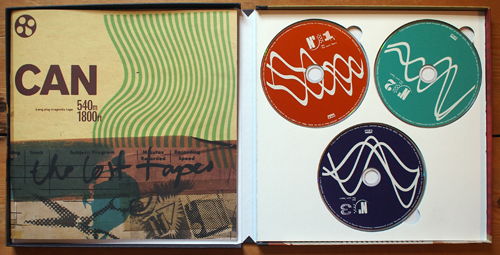
Here for Spoon Records he has created a handsome and sturdy 10″ box to house the 3 disc set, with accompanying 28 page booklet. The box itself, obviously recalls reel to reel tape boxes, which helps set an ‘authentic’ tone of voice for the whole project. The front and back cover theme of cut and paste imagery, with yellowing Sellotape and halftone-screened photographs follows through into the internal graphics perfectly emulating the immediacy of much of the music—Can famously jammed a lot of their material, and the visual language applied to The Lost Tapes mirrors that aesthetic.

It could be argued that this showcases the House style, (pun intended), with the typewriter font, cut and paste approach and seemingly random placements, that he established with his work for Broadcast and Primal Scream. Certainly there are similarities with what he has done before, but the trick with much of his output is to make the work look as if it was thrown together, when in fact there is obvious consideration and a keen designers eye employed throughout. Image selection, editing, cropping and placement rarely look this good when they are done spontaneously—making an attractive scrapbook is not easy.

Uncoated stock helps to instil a tactile sense as the viewer holds this oversized CD packaging to read the comments from band members about the selection process they went through to edit down 50 hours of music contained in the uncovered tapes. There’s even a photograph of the cupboard they found the material in. It is remarkable that so much survived, considering that during times of little money, the band would record over old tapes they had decided weren’t worth preserving.

This is probably one of the major releases of 2012—expect it to keep cropping up in many end of year polls. And as such, it is good to see that the importance of creating visually empathetic packaging for the discs has been held in such high regard, something rare in this era of imageless digital downloads.

I would have bought this as a physical release regardless of the packaging, as I do for all albums that I consider audio quality to be of importance for. But regardless of wanting to possess high quality audio, this package is well worth £30 of anyones money in my opinion. For the first time in a long time, when I stuck on my headphones to listen to the first CD from The Lost Tapes and study the sleeve notes and artwork, I was taken back to a time when I used to do the same with vinyl LPs.
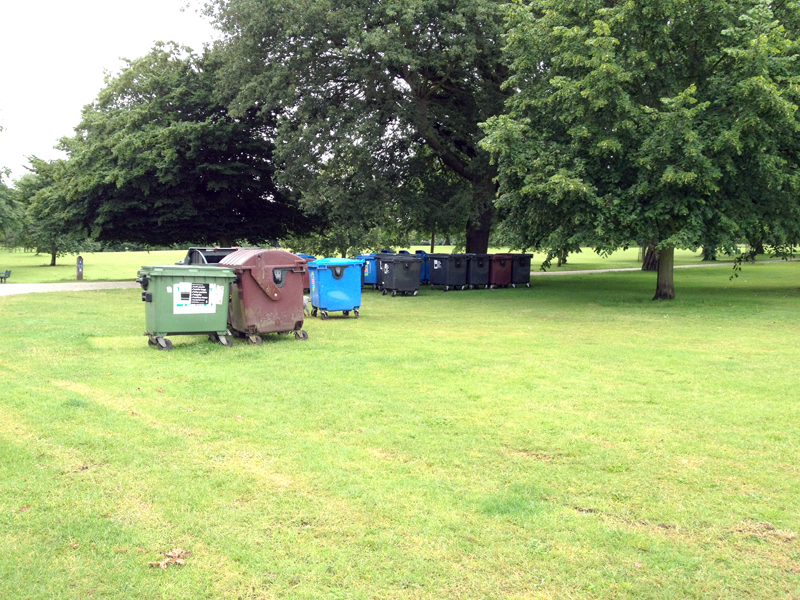
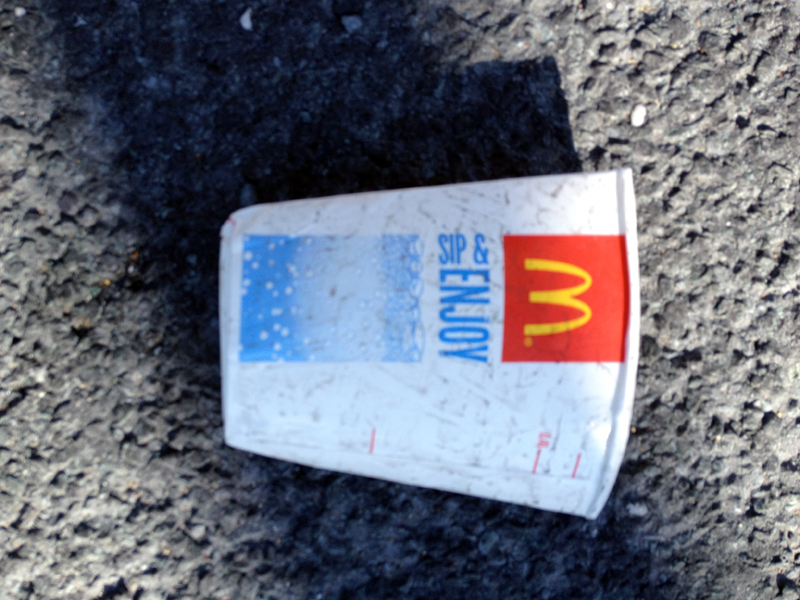
This week I published number 1000 image of McJunk to Flickr. This is a noteworthy occasion, because at the publication of the McJunk photo book in January 2011, I had only just uploaded 500 images. Therefore, in less than one and a half years, I’ve doubled the number of photographs of McDonald’s litter it had previously taken me 9 years to collect. It is difficult to tell whether this is because there is more McJunk out there, or because since the publication of the book, I’ve been more proactive in capturing examples I happen upon.

Whatever the reason, I’ve decided to take a hiatus from McJunk to concentrate my spare time on some other project ideas I’ve been scribbling in notebooks recently. To mark this breathing space, I’ve decided to publicly publish the essay I wrote to accompany the book. I will continue to take submissions to the McJunk project and post them to Tumblr, and the book will still be available—see the McJunk website for details. The McFacebook page will, likewise, continue. And if you are interested in seeing what 1000 piece of McDonald’s litter looks like, please visit the Flickr set.

The essay can be downloaded from the Dubdog Archive page

McJunk number 1000

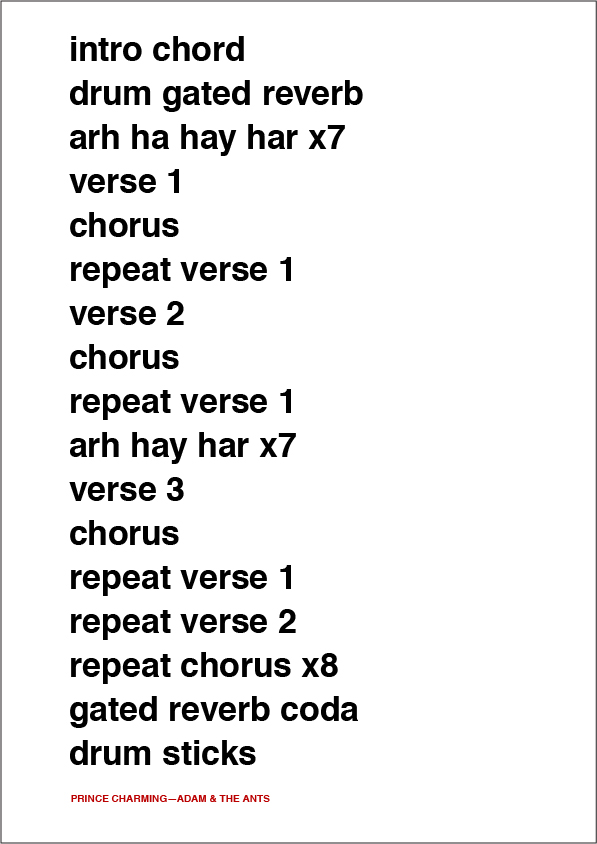
After seeing Adam Ant live last night, I thought it was appropriate to refresh the Prince Charming Songcard I first created in 2006.

Earlier this week, a colleague and I went to the New Designers fair at the Business Design Centre in Islington. Jumping on a Circle Line train at Liverpool Street I was immediately impressed with the brand new tube train we found ourselves on.

Spot the end of the train.

My immediate surprise was how spacious it felt. It took me a few seconds to realise that this was because the eye is taken down the entire length of the train—the doors separating each carriage have gone, replaced by a generously wide space.

Where once there were doors…

Secondly, the seats have been arranged much more appropriately, and they cleverly float off of the floor, giving the illusion of more space as the eyeliner is unbroken as you look at the floor.

So impressed was I with this layout and sense of space, (accepting that the train I got on wasn’t exactly full), the short journey we took was a pleasant experience. I will go as far as to say I was actually slightly excited—I was witnessing intelligently considered design that put the user experience first.

This experience was sharply contrasted when we stepped out of the train at Moorgate, which is a rough and unloved station. To make matters worse, changing to the Northern Line, the deepest of the lines on the London Underground, the lift wasn’t working! This proved problematic for the pensioner in front of us, who struggled with the stairs clinging onto the rail with one hand and a walking stick with the other. Just in front of her was a man with a small child in a pushchair on his own. There could not have been two greater examples of the contrast between the user focussed design I had previously experienced and just how bad this was for people going about their everyday activities, bar there being a wheelchair user on the top step staring blankly ahead.

Pushchair man managed the first flight of stairs, conventional as they were—he was able to bump the chair down on its back wheels. However, when he got to the spiral staircase, he looked exasperated. I therefore offered to help him and carried the front of the pushchair for him. Finally, out of breath and sweating profusely on a humid and muggy summer day, my colleague and I got on a Northern Line train, which was cramped, unfriendly, and had none of the sense of consideration for giving people a quality experience that we had previously felt.

Back to reality

I’m currently putting together a lecture titled ‘What is a book?’ for a sixth form higher education taster day I’m involved in at UCS next week. In the process of my research, I came across this excellent video of Irma Boom talking about her work, which I had never seen before. Unfortunately it is a little too long to include in my lecture, so I thought I would share it here. It is worth 6 minutes of your time.

Ipswich is having a bit of a surge of cultural activity of late, much to the surprise of many of the locals. Sure, for a few years there’s been hi-brow events at the NewWolseyTheatre and Jerwood DanceHouse, and the chattering classes love it when productions in these venues are mentioned in The Guardian Guide.  Alongside this, the annual Ip-Art Festival also brings a cosy but somewhat parochial Gig In The Park, visual art and performance to the town, and big name acts play the football stadium or big parks throughout the year for the X-factor crowd. But for a town with a growing University, a vibrant FE College and culturally diverse population, Ipswich lacks a musical/cultural scene that many other towns of a similar size take for granted. There have always been a lot of gigs over the years, run on a shoe string and in the back rooms of pubs by music obsessives, but you have to know they are happening and they take a little hunting out for anyone new to the town. I’ve stated much of this before on Dubdog, especially earlier this year when there was a call for an Ipswich Arts Centre, (you can read previous posts about this here). But this week sees the Switch Fringe Festival get into full swing which should hopefully start to redress the balance:

The excitement amongst aged local gig goers is palpable as Switch takes the town by storm with its diverse range of acts and culturally rich itineracy. I’m particularly looking forward to seeing the Sons of Joy play the local Labour Club tomorrow night, supported by Nathaniel Robin Mann of The Dead Rat Orchestra.

While I have my gripes about Switch—I think it has an identity problem, Ipswich already has the (albeit performance art focused) Pulse Fringe Festival to rival Ip-Art, and Switch is happening when most of the university students have gone home for the summer—but I can’t knock it for the effort that has gone into making this happen, and that it has created the sense of vibrancy about Ipswich that it hasn’t had for a while. That has got to be a good thing.

Switch will hopefully fuel others to get up and do something in this town, and that, to me, is the beauty of this little festival. It doesn’t feel like it has been organised by the local town council doing something for the ‘kids’, nor does it come across as something created by a cultural elite desperate to get in the pages of coffee table magazine. So all power to Switch, and thanks to those who are involved for making it happen.

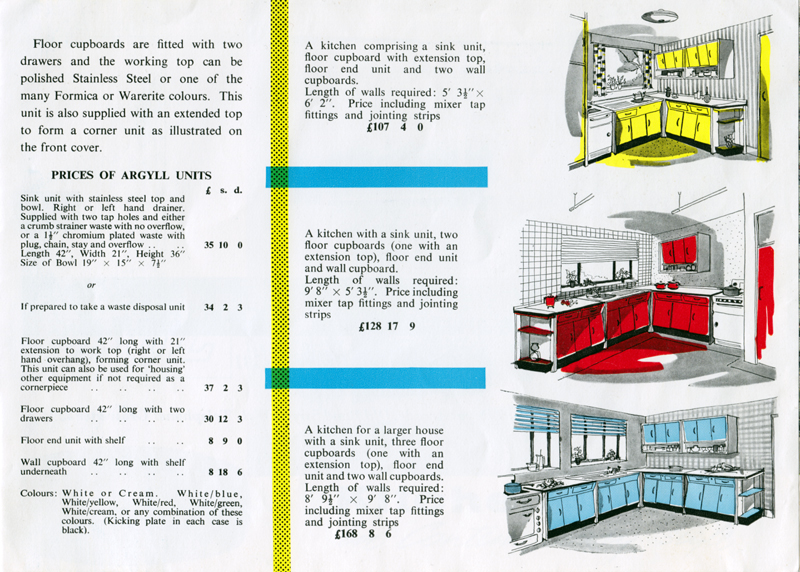
When Claire and I decided to rip out our old, dark wood fitted kitchen, over 10 years ago, it coincided with my Mum becoming an executor for an old family friend who had died. In being charged with clearing their bungalow in Clacton, my Mum didn’t know what to do with the stainless steel Paul kitchen units they had. As she pondered taking them to the local dump, Claire and I shouted, “we’ll have them”, and they’ve stood in our kitchen ever since. However, this post isn’t about how incredibly lucky we were to get hold of these domestic beauties, but about the brochures that came with them, for Fred, the family friend who had passed away, kept all paperwork for everything he had ever bought. As my Mum went through some of this immense amount of paperwork, she came across some wonderful brochures for the W. H. Paul kitchen units that he must have ordered before deciding to make a purchase. I found them again a couple of weeks ago, and thought I would share these relics of a time gone by. As brochures for such items become less and less common, largely due, I guess, to the Internet, and any that are still produced tend to have much less personality than these Mad Men-esque historical documents, they become a fascinating view on early 1960s domestic aspirations.

Below, the cover of one of the many brochures obtained before Fred decided on which units to go for:

The illustrations in this brochure are fantastic, and the graphic devices of blue rectangles and dotted yellow strips to break up the information on the page are evocative of early 1960s layout, pre-modernisms’ Helvetica & photography driven homogeneity, they fashionably signal that these items are desirable and contemporary statement pieces.

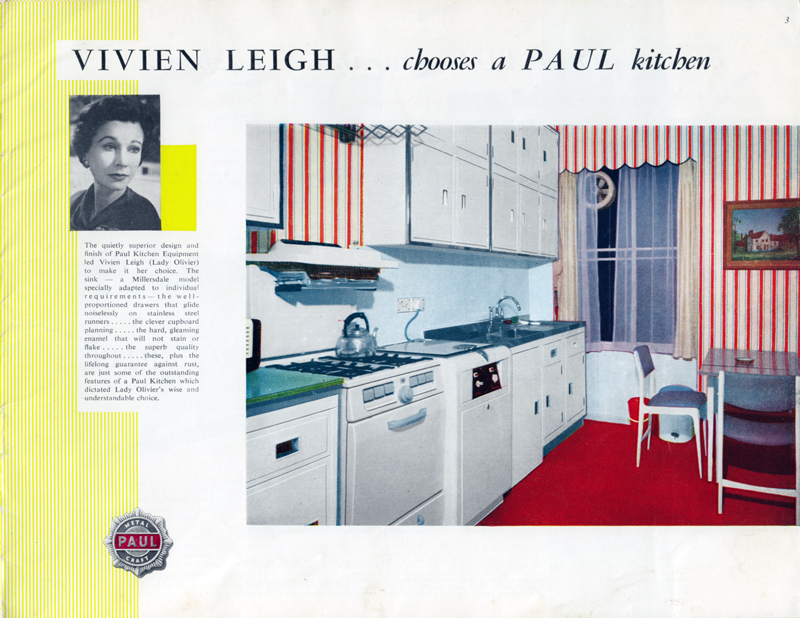
Celebrity endorsement isn’t just a recent phenomenon, as Vivien Leigh professes her love of a Paul kitchen.

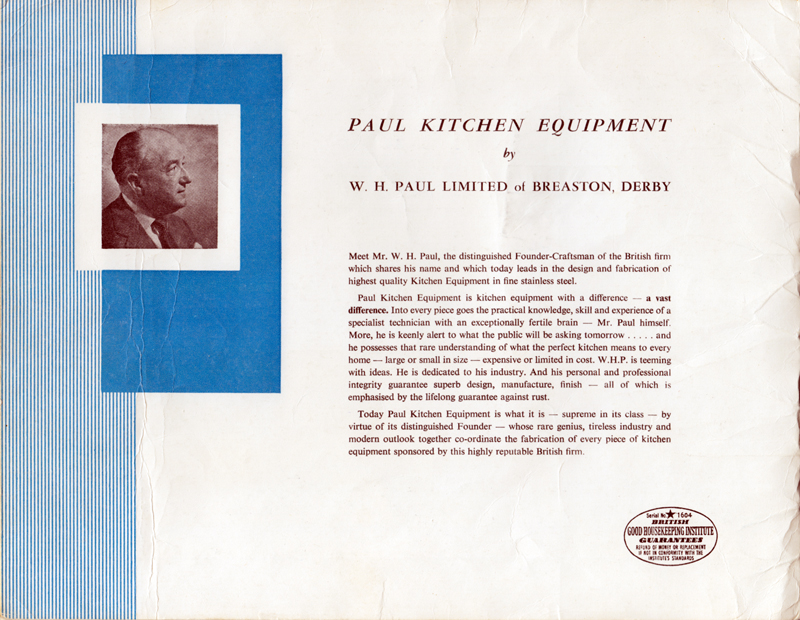
Meet Mr W. H. Paul…

Plan your kitchen layout:


Brochure cover with metal ‘Metal Craft’ Paul logo attached.

Unfortunately the sink unit we got didn’t have this ‘secret’ Wash Wonder component.

Other Paul wonders available, the Warma and Warmette.

Looking somewhat different to the illustrations and photographs in the brochures; the sink unit in our kitchen. I wonder whether Vivien Leigh would approve?

The accompanying letters found with these brochures tell that Fred bought the units in 1961, directly from W. H. Paul Limited, in Breaston, Derby. 52 years later, the brochure claims are as good as their word, and there isn’t a trace of rust on any of them. This is lucky for us, as a quick search on Google doesn’t seem to tell whether W. H. Paul are still in business, so we may have had trouble claiming against the lifetime guarantee if there was a trace of rust on them.

Mark Stewart w/ fig rolls

It is good to see that BBC4’s Punk Britannia ended on a high note as it looked at Post Punk, after my previous comments here. I was not in the mood to be disappointed, having blown out a gig I really wanted to go to because I felt unwell earlier in the day, (sorry Rocky). Several medicinal whiskeys later, and laying on the sofa, I was braced for an anticlimax to an anticlimax. But it did the period of 1978–1981 some justice, with most of the key names present; The Fall, Magazine, PiL, Gang of Four, The Slits, Wire, etc. It strayed into anarcho-punk, electronica, and Two Tone, but still took a wide berth around industrial music. There was much else missing as well, just like in the previous programme, and again, it focussed mostly on music. Although their was a brief section that broke off to talk about how Rough Trade changed the music industry; there was still a distinct lack of discussion about other art, design and media revolutions in the wake of punk, such as fashion, publishing, broadcasting and graphic design.

The harking on about the grimness of the 1970s started to grate after a while, but the talking heads were genuinely funny, despite the austere music that came from many of them. Jah Wobble eulogised his love of bass, and clay pigeon shooting, (!); Mark E Smith slurred along with a can of Tennents ever present, (the logo was blurred, I guess, at Tennents’ request of not wanting him to be an advert for their product, rather than advertising censorship from the beeb); Colin and Graham from Wire came across like an old married couple as Graham objected to Colin stating they were grumpy old grand dads; and Mark Stewart out-quoted John Lydon, having Claire and I in stitches of laughter at various points: “Punk is about experimenting… not about some fat fart lecturing you about Punk on BBC4”, with his packet of fig rolls on the coffee table as ever present as Smith’s can of lager.

If you know nothing of any of the bands discussed in this post, go watch the programme, this one felt at least a little educational, and is certainly entertaining.

For the second year running, Snape Maltings in Suffolk has hosted SNAP: Art At The Aldeburgh Festival.

Emily Richardson’s Over The Horizon in Derelict Building A

Like last year, one of the things I like most about this exhibition is its inventive use of the space at Snape Maltings. Old derelict buildings and the beautiful scenery of Snape become temporary gallery spaces through projections, sound scapes and integration with the landscape. In fact, the siting of the work is often better than the work itself, and the location brings something of an improvement. For example, I was rather taken with the work above by Emily Richardson, which married a slideshow of stills of derelict buildings on Orford Ness on the Suffolk coast—something of a common art/photography project in these parts of the world—with sounds recorded there. The effect of derelict buildings displayed in derelict buildings had a mesmerising effect as the framing of the work became part of the work, despite the fact I’ve seen many Orford Ness projects to make me scream ‘enough already’ when ever I see another.

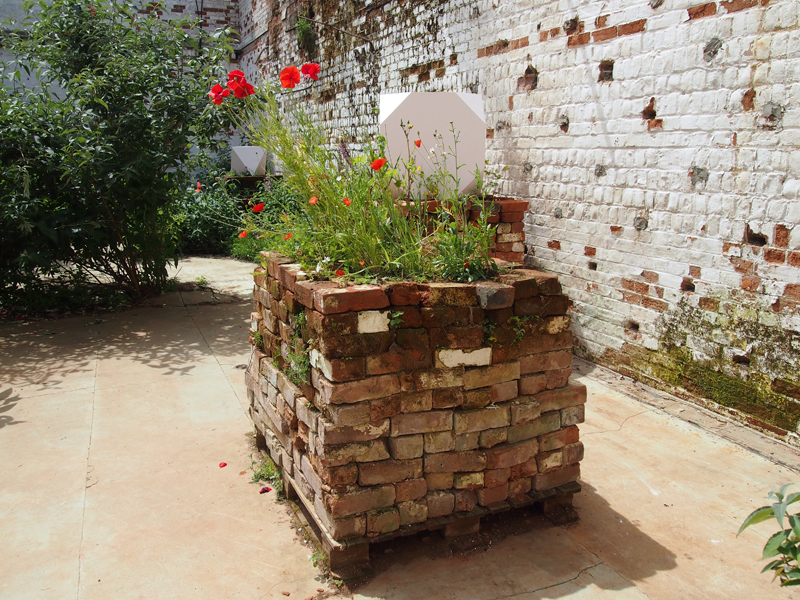
May Cornett’s Walled Garden

Some of the work is striking and I particularly liked May Cornett’s Walled Garden, with a series of pallets of bricks making giant raised flower beds. I’d debate that this was more design than art, and I’d readily have several of these in my garden.

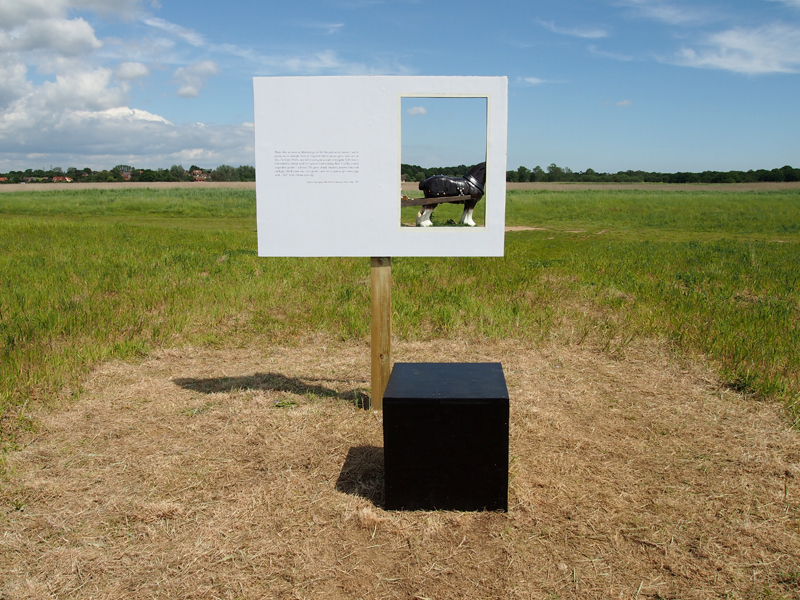
Matthew Darbyshire & Scott King’s Ways of Sitting, with Sarah Lucas’ Perceval

Matthew Darbyshire and Scott King’s Ways of Sitting framed existing artwork dotted around various locations at the Maltings, with ‘quotes’ by King that poke fun at artist mythology. Some of the texts were a little obtuse and appeared to lack pertinence to the work they coincided with, although a couple, such as a ‘quote’ from Nancy Spungen about wanting to raise animals in the country with Sid Vicious next to Perceval by Sarah Lucas, did make me laugh.

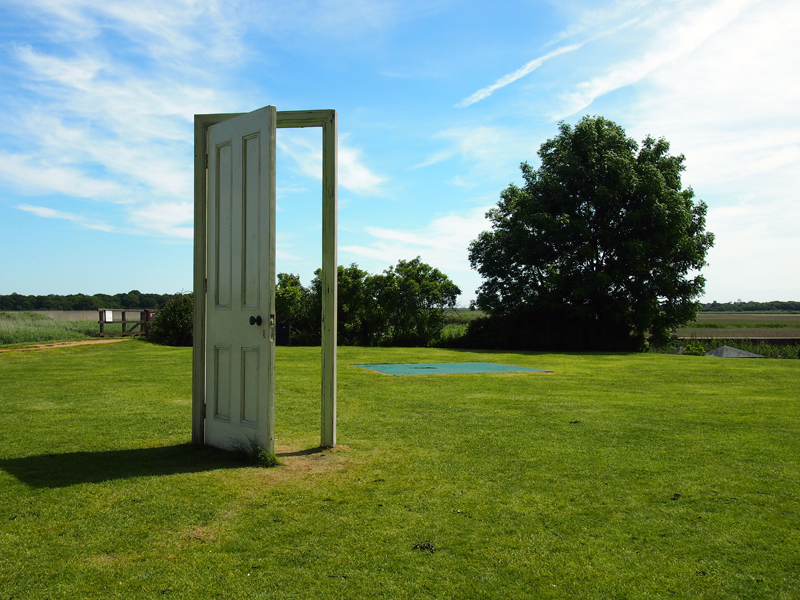
Gavin Turk’s L’Age d’or

I also enjoyed Gavin Turk’s oversized door, there was something very Alice in Wonderland about it, and my Grandson loved running through it. (Apologies for the saturated colour in these two shots, my camera changed settings without me realising.)

Callie and Alfie and Gavin Turk

Overall, an exhibition worth visiting. Other artists on display include Glenn Brown, Brian Eno, Aston Ernest, Ryan Gander, Maggi Hambling, and Mark Limbrick. The exhibition runs until 24 June.