Archive

Music

TheShipSongSingle

Next weekend I’m cashing in a Christmas present from Claire—a day at Winklebag Press in the middle of the Suffolk countryside. There I hope to learn how to use an Adana ‘Eight-Five’ letterpress tabletop printer, also a present from Claire.

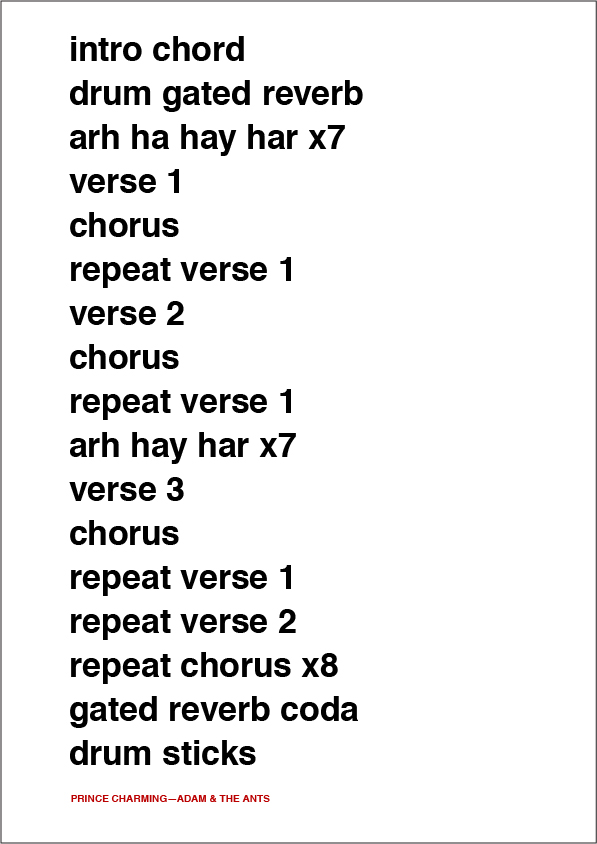
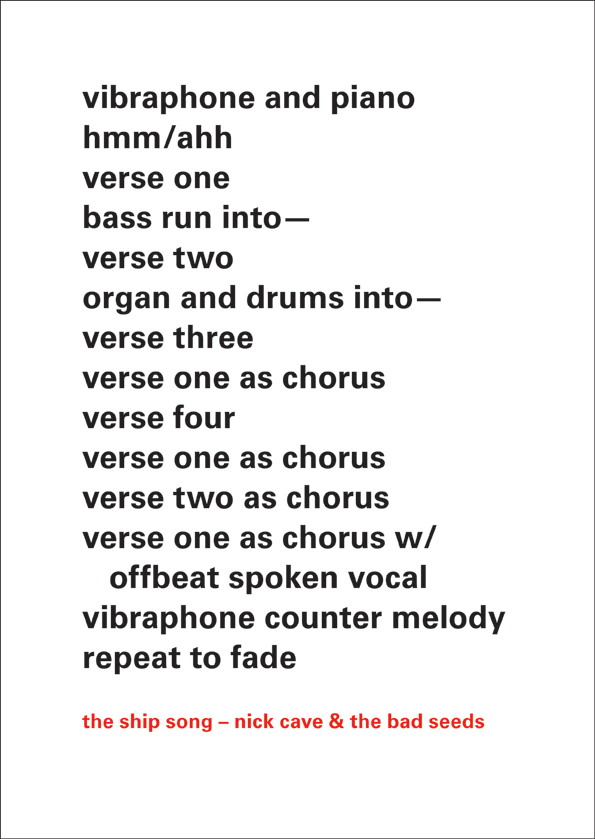
For my inky day out, I’ve artworked a new title for my Songcard project, (switching Helvetica for Univers in the process as Winklebag have limited typefaces), in honour of our 10th wedding anniversary.

Photos of my progress will follow after next week.


I used to think of myself as an album person, preferring to listen to an album all the way through, rather than choosing one or more tracks selectively. Many of my favourite bands wrote and released material specifically for the format. However, with a love of shuffle on my iPhone and being extremely disappointed with the When LPs Ruled The World ‘season’ on BBC4 this week, I’m beginning to change my mind about the album’s importance.

The most interesting aspect of this season was Danny Baker’s Great Album Showdown, although the concept of sitting around talking about LPs with only the occassional track being played to illustrate one of Baker’s contextual monologues, felt at complete odds with the format being discussed. The series looked at Rock, Pop and RnB in turn. During the Rock programme, being subjected to Jeremy Clarkson stating that The Clash were a more appropriate soundtrack to the Grunwick strike unfolding on television in the 1970s than the heavy rock he previously listened to, while salient, was strangely unsettling a statement to hear the double denim fashionista make—unsettling because the thought of the politically right of centre Clarkson listening to The Clash and watching striking workers with sympathy on TV made me want to burn my copy of Sandinista. The Pop edition featured the ever listenable Boy George, alongside the ever annoying Grace Dent. Overall, the best of the three programmes was the RnB episode, which at least did seem to have a genuine socio-political take within the discussion on the rise of the genre and in doing so, made some justification for the importance of holding such a discussion. Martin Freeman proved to be an enthusiatic and informative fan, while Trevor Nelson was an eloquent and intelligent counterpoint to the histrionics of Mica Paris.

Despite this, Baker demonstrated a deft approach to handling his guests pontifications on all things vinyl, being an amiable and knowledgable host. It remained, however, a questionable format for a programme that seemingly never quite understood what its true identity was; part chat show, part discussion panel, part history lesson, part music show, part debating society. None of these truly shone through as a raison d’être and the whole felt nostalgically irrelevant and vapid.

The main Friday night programme that Baker’s triptych built up to was, unfortunately, completely disappointing, and at times, factually incorrect. As a result of all this, I was left asking: what exactly was the point of this ‘season’ other than filling schedules with cheap TV?

And so, as I continually reassess how I consume music, and the more I am distanced from my own past by such poor TV programming, I can’t help thinking that Bill Drummond has a point in the Singles Verses Albums film he made after turning down the offer to contribute to this series of programmes:

And so to the annual round up of what I’ve been listening to over the last 12 months. There have been some real disappointments in 2012, (Animal Collective, The XX, Julian Cope; to name a few), and there has been nothing completely ‘new’ that has knocked me for six. Death Grips came close, but I’m convinced that was as much to do with the hype as anything else. A storm in a teacup me thinks, albeit one that is almost the perfect accompaniment to a dying music industry.

This year I discovered some old music that did excite me though. The first up was Can, which considering my post-punk tastes, is surprising that I hadn’t listened to them before, taking into account how influential they were to many of the innovative bands that came immediately after the Sex Pistols et al. I heard a Can track on the radio early in January, I can’t remember which song it was, and it blew me away. Was this really the same band that I had passed off as a bunch of hippies in my teens? (Although now I think about it, I may have got them mixed up with Gong back then). I immediately trawled iTunes, and after listening to various tracks and reading several reviews, plumped to download ‘Tago Mago’. I couldn’t believe that I had previously dismissed this band. And when ‘The Lost Tapes’ came out in Spring—unearthed recordings that (mostly) hadn’t seen the light of day—I snapped it up. This release, without a shadow of a doubt, is easily my favourite record of 2012.

A similar experience happened when I discovered Brian Eno’s early work this year. Obviously I knew Roxy Music, and of Eno’s work with Bowie and Talking Heads. I also own several of his more recent ambient releases. However, I knew nothing of his first few solo albums until Mark Riley played ‘Needles In A Camel’s Eye’ from ‘Here Comes The Warm Jets’ on 6music. Why had I not heard this until I reached my 44th year? How could that happen? Needless to say I quickly bought ‘Warm Jets’, ‘Taking Tiger Mountain By Strategy’, and later in the year, ‘Before And After Science’. Thanks Mark.

Discovering pre-Midge Ure Ultravox was a pleasant surprise as well, after a friend did me a copy of ‘Ha! Ha! Ha!’ Considering that all I knew of them was the 1980s pomp they produced when I was in my teens, and automatically hated, this was a revelation and got me questioning how many other bands have shamed their preceding history by their later output? While I never thought I had heard it all, I was surprised to discover so much old music that was so good this year, which means there is potentially lots more out there waiting to be discovered. This, in itself, is probably the single most exciting thought I’ve had about music in recent years.

There have been some good re-releases and compilations this year which, keeping on the old music theme, kept me going considering the brevity of exciting new material. Keith Hudson’s ‘Rasta Communication’, The Beat’s first two albums, various Lee ‘Scratch’ Perry and Joe Gibbs compilations have kept the Dubdog happy. Rediscoveries included The Fall’s I Am Kurious Oranj, which proved not to be as good as I remember it being first time around, The Stranglers’ ‘The Raven’, which did prove to be as good as the first time around, if not better; and Crass’s ’10 Notes On A Summer’s Day’ was rewarding in a way it wasn’t first time around.

As for new music, it is always good to hear the strained tones of Mark Stewart, regardless of the quality of the music that is backing him. Burial has continued to be interesting, and DELS released an EP at the end of the year which makes his album due in 2013 one to be on the watch list. The Mogwai and Björk remix albums were different enough from their originals to be included in this list, and both had some great moments. The first half of The Pre New’s ‘Music For People Who Hate Themselves’ got repeat playings when it was first released, particularly while driving, but David Byrne and St Vincent’s brass band experiment proved ultimately too much across an entire album for me, which means as a whole, I haven’t really given it the time of day such a work probably deserves. Godspeed and The Swans returned, literally with (musical) vengeance, and I never thought I would ever listen to Neneh Cherry again in my life, but her work with jazz trio The Thing is inspired, particularly their take on The Stooges ‘Dirt’. And lastly, two albums distinctly different from each other that I couldn’t help returning to over and over again, were Chairlift’s ‘Something’, which reminded me of Pauline Murray and The Invisible Girls first album, (sadly not available digitally); and Wrongtom and Deemus J’s ‘In East London’, which careers over pretty much every dancehall and reggae sub-style you can imagine, and is all the more enjoyable for it.

So that’s my recorded year. Live, edited highlights include The Ex with Brass Unbound who were phenomenal, (as was the whole evening they curated at Cafe OTO early in December). Liars bought WIXIW to life in Norwich and are now on my list of bands to go out of my way to see when ever they tour the UK again. King Creosote and Jon Hopkins gave a very special and atmospheric performance of Diamond Mine, again, in Norwich. Other folk included Billy Bragg playing Woody Guthrie at the John Peel Centre in Stowmarket, and the instrumental Spiro at the newly formed Folk East Festival were excellent with their post-rock take on folk music, (my pretentious description). Nathaniel Robin Mann was incredible not once, but twice in Ipswich and at Folk East—check him out, there’s plenty on YouTube, you will NOT be disappointed. However, I can’t complete the list without mentioning how much fun it was seeing Adam Ant play in Ipswich. He’s not someone I would have travelled far to see, but as ‘Dirk Wears White Sox’ is a favourite album of mine, I felt obliged as he was only down the road. The set predominantly featured punk-Ants material, which worked surprisingly well after all these years and kept me happy, and the enthusiasm among the packed crowd for the pop-Ants tracks was infectious. However, as tempting as it was, I managed to resist doing the Prince Charming dance.

The List

The Conversation (The Original Soundtrack) – David Shire
Lee “Scratch” Perry – Nu Sound & Version
Gold Panda – DJ-Kicks
Guided By Voices – Let’s Go Eat The Factory
Can – Tago Mago (40th Anniversary Edition)
Ultravox! – Ha!-Ha!-Ha!
Josh T. Pearson – Last Of The Country Gentlemen
Chailift – Something
Gonjasufi – Mu.Zz.Le
Yannis Kyriakides & Andy Moor – Rebetika
Brian Eno – Here Come The Warm Jets
Django Django – Django Django
Leonard Cohen – Old Ideas
Agnostic Mountain Gospel Choir – Ten Thousand
MGMT – Congratulations
Various – The Wire Trapper 26 (Edit)
Dub Colossus – Dub Me Tender Vol 1 & 2
Brian Eno – Taking Tiger Mountain by Strategy
Barry Adamson – I Will Set You Free
DJ Food – The Search Engine
Portico Quartet – Portico Quartet
Burial – Kindred EP
The Stranglers – The Raven
Field Music – Plumb
Electricity In Our Homes – Dear Shareholder
R.U.T.A – Gore
Paul Weller – Sonik Kicks
The Fall – I Am Kurious Oranj
Mark Stewart – The Politics Of Envy
Spiro – Kaleidophonica
Trembling Bells and Bonnie ‘Prince’ Billy – The Marble Downs
Joe Gibbs – Scorchers from the Early Years (1967–1973)
Joe Gibbs – Scorchers from the Mighty Two
The Pre New – Music For People Who Hate Themselves
Death Grips – The Money Store
Public Image Ltd. – One Drop EP
Public Image Ltd. – This Is PiL
Dubwood Allstars – Underdubwood
Various – Ska-ing West
Various – Mento & RnB
The Beat – I Just Can’t Stop It (Deluxe re-release)
The Beat – Wha’ppan (Deluxe re-release)
Liars – W I X I W
Various – Wire Tapper 29
Crass – 10 Notes On A Summers Day
Julian Cope – Psychedelic Revolution
Nathaniel Robin Mann – Animateddog’s Scraps 2: The Gathered Flecks Of Hope And Sorrow
Robert Wyatt – Nothing Can Stop Us
Beak> – >>
Dead Rat Orchestra – The Guga Hunters of Ness
Dirty Projectors – Swing Lo Magellan
Can – The Lost Tapes
Can – Monster Movie/Delay 1968
The Ex – Joggers and Smoggers
Amadou & Mariam – Folila
Micachu and The Shapes – Never
The Ex – Dignity Of Labour
The Fall – This Nation’s Saving Grace
Gallon Drunk – The Road Gets Darker From Here
Various – Deep Roots Observer Style
Matthew Dear – Beams
Four Tet – Pink
Adrian Sherwood – Survival & Resistance
The Raincoats – Moving
David Byrne & St. Vincent – Love This Giant
Animal Collective – Centipede Hz
The xx – Coexist
Getatchew Mekuria + The Ex + Friends – Y’Anbessaw Tezeta
Jack Lewis and Awkward Energy – Lvov Swims The Williamette
Brian Eno – Before and After Science
Death Grips – No Love Deep Web
The Swans – The Seer
The Mountain Goats – Transcendental Youth
Godspeed You! Black Emperor – Allelujah! Don’t Bend! Ascend!
Keith Hudson – Rasta Communication
Wrongtom Meets Deemas J – In East London
Neneh Cherry and The Thing – The Cherry Thing
Bo Ningen – Line The Wall
Esbjörn Svensson Trio – 301
Lee ‘Scratch’ Perry and Friends – Disco Devil: The Jamaican Discomixes
Various – Reworks_: Philip Glass Remixed
Photek – Ku:Palm
Björk – Bastards
Mark Stewart – The Exorcism of Envy
Mogwai – A Wrenched Vile Lore
Scott Walker – Bish Bosch
Brian Eno – Lux
Anne-James Chaton & Andy Moor – Le Journaliste
Burial – Truant / Rough Sleeper
DELS – Black Salad EP
I received David Byrne’s new book, How Music Works, through the post yesterday. It is a beautifully produced object. The cover is subtly padded, (as if the book itself was actually sound proofed), while the layout is sensitively understated.

Book cover for David Byrne's How Music Works

Spread from How Music Works

Byrne pulls on his vast experience as a musician to explore how technological changes in the production of music has affected music itself, looking at what it means to go on stage, and many other associated topics. Therefore, it is both part autobiographical, and, as he puts it himself, a series of ‘think pieces’.

Byrne avoids being highly technical, as well as steering clear of stories about rock star excess and redemption, it is therefore the perfect antidote to the ego massaging rockumentaries being spewed out by the BBC of late. This is not a trawl through the history of his many musical projects, although they are used as a contextual sounding board to discuss the business of music, (as opposed the the music business). As an introduction to some of the contexts discussed, and the self-effacing nature of the man himself, it is well worth watching the Ted.com talk Byrne gave in 2010, where he talks about how architecture has helped to shape the evolution of music.


Still from the fil Ride Rise Roar

Spread from How Music Works‚ (a still from the film Ride Rise Roar)

Intelligent and accessible, interesting and engaging, this book comes highly recommended.

Someday All The Adults Will Die: Punk Graphics 1971–1984, opened at the Hayward Gallery last week.

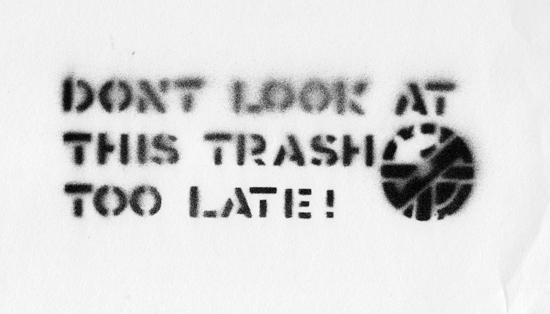
Crass stencil

To coincide with the opening private view, curator Johan Kugelberg hosted a panel discussion of some key designers involved in early punk graphics, along with cyberpunk author William Gibson. Apologising for co-curator Jon Savage’s absence—who was very punk by being on holiday with his mum—Kugelberg introduced Gee Vaucher, who created all the graphics that surrounded Crass‘ musical output, Tony Drayton of Ripped & Torn fanzine fame, and John Holmstrom, the man behind the American Punk magazine.

The discussion was pushed along admirably by Kugelberg, prompting anecdotes from Gibson about hearing both The Beatles’ Sgt Peppers, and Velvet Underground’s first LP within weeks of each other on their release in 1967. He came away thinking the Velvets the more important work because of the shock value it contained, and the fact that lots of people didn’t like it. (I have to say I agree with him.) Holmstrom also spoke about the impact of seeing the Ramones in 1974, and Vaucher about how Freddie Laker’s cheap air fairs helped punk bands play across the Atlantic divide. However, it was strange how music only entered the discussion as a separate entirety from graphic design, and I came away thinking it disappointing that the relationship between the similar creative processes involved in making punk music and punk graphics wasn’t discussed in any depth. This may be a result of Vaucher and Holmstrom’s art school background—they weren’t untutored kids working it out for themselves in the same way that many bands and artists were. While Vaucher’s work may look like photomontage, the anti-art form first championed by Dada artists, it is in fact painted in gouache. But to overlook the relationship between creative approaches to different art forms, and how similar processes arguably tied them together, is a glaring omission.

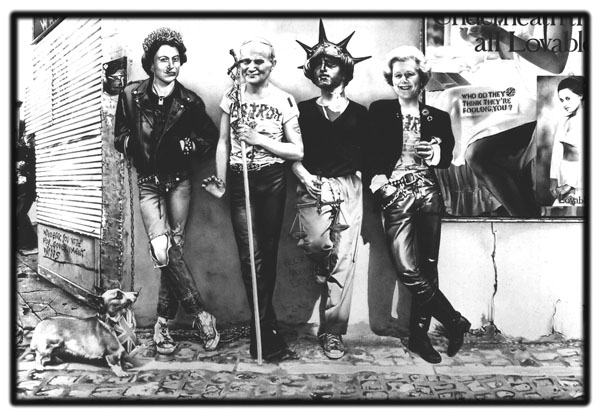
Gee Vaucher’s punk self-commentry—The Sex Pistols become figureheads of the State.

Refreshingly, Tony Drayton, while not explicitly talking about musicianship, or lack of it, did discuss making his first rough and ready Ripped & Torn fanzine, and how speaking to The Damned at the bar of one of their gigs became the interview he would include in one of the issues. Initially being inspired by Mark P’s Sniffin’ Glue, he created his own version using a photocopier at his place of work. Producing only 10 copies, he sent several out to, among others, Compendium bookshop in London, and was then shocked to get a request for 200 more for them to sell. This legitimisation and acceptance into the ‘scene’ was one of the most interesting aspects raised. And in fact, when looking around the exhibition itself, the sense of ‘anyone can do it’ shines through. The buzz of creating something, of it becoming a legitimate artefact through production, something you’d only previously seen professionals making, helped to launch many a career. Sure, there is a lot of poor artwork on display here, as you would expect. But the fact that punk allowed those who hadn’t gone, (or even dreamt of going), to art school to find an innate talent and drive, is one of the truly revolutionary things about the movement, both musically and graphically. Add to this the raw nature of much of the visuals, their aesthetic dictated by limited means of production, and ideas and content rise above concerns about production values. The immediacy, even urgency of the process, is obvious in much of the work throughout the exhibition, which further creates a kinetic energy to what is displayed.

It is good to see that Kugelberg and Savage have included early situationist texts and graphics here too. Debord and Atelier Populaire are on display, along with King Mob, who up until this point I had only read about and never actually seen any of their visual output. The politics of these movements are echoed throughout much of the punk music graphics, particularly that of Crass. These influences are obvious and this fluid idea of what punk graphics are eschews what Vaucher called the ‘BBC or Guardian filter’ of what constitutes punk in mainstream media. The exhibition is also interesting because much of the work wasn’t created with longevity in mind. Thanks to the personal collections of Kugelberg and Dial House, (Penny Rimbaud and Gee Vaucher’s communal house that was home to Crass Records for many years), this important exhibition showcases a period that touches design, music, politics and cultural history, and is available for all to see with the potential of reaching an even bigger audience than much of it did first time around.

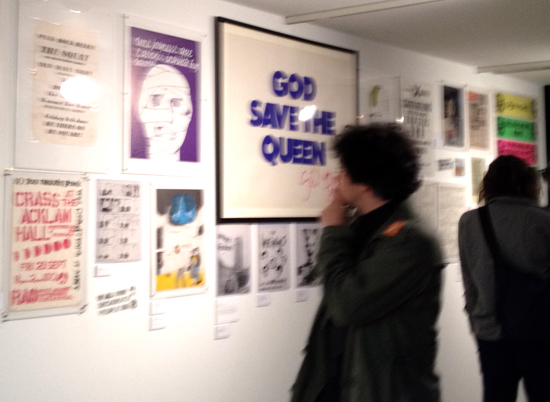
Someday… private view

All in all, the discussion panel was thought provoking. I proudly came away with a Crass stencil that Kugelberg had made using an original Crass cut out on display in the exhibition, to raise money for Pussy Riot. The influence of punk, and punk itself, as he claimed, lives on.

Someday All The Adults Will Die: Punk Graphics 1971–1984, continues at the Hayward Gallery, London, until 4 November, and is highly recommended.

P.S Apologies for the poor quality of the private view image—blame the ridiculous ‘no photos’ policy of British galleries resulting in hasty shooting.

There is much talk about The Lost Tapes by Can at the moment, and with good reason. For those reading this that know nothing about the band, or the context within which they emerged, then there is an excellent essay on Quietus by Taylor Parkes that comes with a Dubdog recommendation. However, the point of this post isn’t to talk about Can, or the fact that these lost tapes were only rediscovered recently, or the importance of the band and their music, but to discuss the artwork and packaging.

The graphic design is done by Julian House at Intro, who is no stranger to music related projects. He has worked with many bands in his time at Intro, as well as setting up a label, Ghostbox, which bares all the visual hallmarks of his distinctive 1950s styling. Although it is a term I usually try to avoid using, but ‘retro’ can appropriately be applied to what he does for Ghostbox releases and label identity.

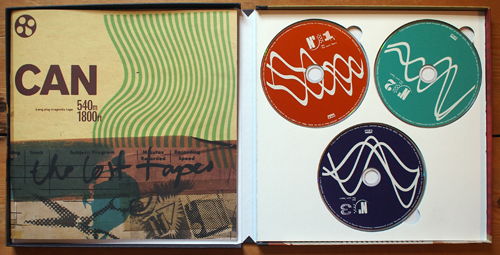
Here for Spoon Records he has created a handsome and sturdy 10″ box to house the 3 disc set, with accompanying 28 page booklet. The box itself, obviously recalls reel to reel tape boxes, which helps set an ‘authentic’ tone of voice for the whole project. The front and back cover theme of cut and paste imagery, with yellowing Sellotape and halftone-screened photographs follows through into the internal graphics perfectly emulating the immediacy of much of the music—Can famously jammed a lot of their material, and the visual language applied to The Lost Tapes mirrors that aesthetic.

It could be argued that this showcases the House style, (pun intended), with the typewriter font, cut and paste approach and seemingly random placements, that he established with his work for Broadcast and Primal Scream. Certainly there are similarities with what he has done before, but the trick with much of his output is to make the work look as if it was thrown together, when in fact there is obvious consideration and a keen designers eye employed throughout. Image selection, editing, cropping and placement rarely look this good when they are done spontaneously—making an attractive scrapbook is not easy.

Uncoated stock helps to instil a tactile sense as the viewer holds this oversized CD packaging to read the comments from band members about the selection process they went through to edit down 50 hours of music contained in the uncovered tapes. There’s even a photograph of the cupboard they found the material in. It is remarkable that so much survived, considering that during times of little money, the band would record over old tapes they had decided weren’t worth preserving.

This is probably one of the major releases of 2012—expect it to keep cropping up in many end of year polls. And as such, it is good to see that the importance of creating visually empathetic packaging for the discs has been held in such high regard, something rare in this era of imageless digital downloads.

I would have bought this as a physical release regardless of the packaging, as I do for all albums that I consider audio quality to be of importance for. But regardless of wanting to possess high quality audio, this package is well worth £30 of anyones money in my opinion. For the first time in a long time, when I stuck on my headphones to listen to the first CD from The Lost Tapes and study the sleeve notes and artwork, I was taken back to a time when I used to do the same with vinyl LPs.

After seeing Adam Ant live last night, I thought it was appropriate to refresh the Prince Charming Songcard I first created in 2006.

Ipswich is having a bit of a surge of cultural activity of late, much to the surprise of many of the locals. Sure, for a few years there’s been hi-brow events at the NewWolseyTheatre and Jerwood DanceHouse, and the chattering classes love it when productions in these venues are mentioned in The Guardian Guide.  Alongside this, the annual Ip-Art Festival also brings a cosy but somewhat parochial Gig In The Park, visual art and performance to the town, and big name acts play the football stadium or big parks throughout the year for the X-factor crowd. But for a town with a growing University, a vibrant FE College and culturally diverse population, Ipswich lacks a musical/cultural scene that many other towns of a similar size take for granted. There have always been a lot of gigs over the years, run on a shoe string and in the back rooms of pubs by music obsessives, but you have to know they are happening and they take a little hunting out for anyone new to the town. I’ve stated much of this before on Dubdog, especially earlier this year when there was a call for an Ipswich Arts Centre, (you can read previous posts about this here). But this week sees the Switch Fringe Festival get into full swing which should hopefully start to redress the balance:

The excitement amongst aged local gig goers is palpable as Switch takes the town by storm with its diverse range of acts and culturally rich itineracy. I’m particularly looking forward to seeing the Sons of Joy play the local Labour Club tomorrow night, supported by Nathaniel Robin Mann of The Dead Rat Orchestra.

While I have my gripes about Switch—I think it has an identity problem, Ipswich already has the (albeit performance art focused) Pulse Fringe Festival to rival Ip-Art, and Switch is happening when most of the university students have gone home for the summer—but I can’t knock it for the effort that has gone into making this happen, and that it has created the sense of vibrancy about Ipswich that it hasn’t had for a while. That has got to be a good thing.

Switch will hopefully fuel others to get up and do something in this town, and that, to me, is the beauty of this little festival. It doesn’t feel like it has been organised by the local town council doing something for the ‘kids’, nor does it come across as something created by a cultural elite desperate to get in the pages of coffee table magazine. So all power to Switch, and thanks to those who are involved for making it happen.

Mark Stewart w/ fig rolls

It is good to see that BBC4’s Punk Britannia ended on a high note as it looked at Post Punk, after my previous comments here. I was not in the mood to be disappointed, having blown out a gig I really wanted to go to because I felt unwell earlier in the day, (sorry Rocky). Several medicinal whiskeys later, and laying on the sofa, I was braced for an anticlimax to an anticlimax. But it did the period of 1978–1981 some justice, with most of the key names present; The Fall, Magazine, PiL, Gang of Four, The Slits, Wire, etc. It strayed into anarcho-punk, electronica, and Two Tone, but still took a wide berth around industrial music. There was much else missing as well, just like in the previous programme, and again, it focussed mostly on music. Although their was a brief section that broke off to talk about how Rough Trade changed the music industry; there was still a distinct lack of discussion about other art, design and media revolutions in the wake of punk, such as fashion, publishing, broadcasting and graphic design.

The harking on about the grimness of the 1970s started to grate after a while, but the talking heads were genuinely funny, despite the austere music that came from many of them. Jah Wobble eulogised his love of bass, and clay pigeon shooting, (!); Mark E Smith slurred along with a can of Tennents ever present, (the logo was blurred, I guess, at Tennents’ request of not wanting him to be an advert for their product, rather than advertising censorship from the beeb); Colin and Graham from Wire came across like an old married couple as Graham objected to Colin stating they were grumpy old grand dads; and Mark Stewart out-quoted John Lydon, having Claire and I in stitches of laughter at various points: “Punk is about experimenting… not about some fat fart lecturing you about Punk on BBC4”, with his packet of fig rolls on the coffee table as ever present as Smith’s can of lager.

If you know nothing of any of the bands discussed in this post, go watch the programme, this one felt at least a little educational, and is certainly entertaining.

The BBC is doing Punk this month, with Punk Britannia on BBC4 on Friday nights, along with a host of associated programmes, while 6music is having a month of Punk with guest DJs and themed programming.

A month is a long time, especially when most things I’ve watched and heard so far are bereft of analysis; tending to veer between re-documentation and nostalgia. In the words of Crass, I’m left asking, ‘so what?’

Here’s a round up so far:
Firstly, the good. The Evidently…John Cooper Clarke documentary was excellent. Intelligent, honest, respectful and it held no prisoners in terms of discussing Clarke’s heroin addiction. None of the ‘stay away from drugs, kids’ patronising schtick you usually get from celebrities who come out the other side of smack. With John Cooper Clarke it is more a case of it happened, he moved on, he survives. The messages are left for the audience to deduce, and the fact he couldn’t write for almost 20 years while under the influence, with his regret written across his face, says more than any rhetoric could. Clips of him reading his poetry were mixed from different eras, with some (unusually) perceptive talking head pieces from those that have been long time fans. Well worth watching, and the best thing that has been on so far.
This Friday BBC4 screened an Arena special called Who is Poly Styrene? Made in 1979, it follows the band X-Ray Spex in the studio, sound checking, and in the back of a van on the road, with a rambling monologue from Poly Styrene herself. It had a distinctively fitting ‘distant’ feel, and Poly came across phased and remote most of the time. The overall effect was compelling, and very 1979.
The previous week I fell asleep through much of We Who Wait: TV Smith & The Adverts, which appeared interesting, but not enough to keep me awake. But then I never ‘got’ The Adverts, and have had many arguments with friends about their supposed greatness.
I have so far missed the first two month of Sunday’s guest DJ slots on 6music, where John Lydon and Siouxsie Sioux chose records to play, but I have caught some ridiculous features on different programmes, such as listeners phoning in with their most ‘punk moment’, “but nothing illegal please”, came the caveat from Nemone this morning. Hmmmm! Unfortunately, I will have to listen to this trite again as I missed the interview with Viv Albertine of The Slits.

In terms of the flagship programming for this series though, the Punk Britannia Friday night triptych, it has so far been a mixed, and disappointing bag. The first looked at Pre-Punk, and was genuinely interesting, discussing how pub rock in the mid 1970s helped to fuel the desire for live music in London for anything that wasn’t Prog Rock. However, it completely failed to mention the importance from the US music scene, in terms of what followed. I understand that this series is about British music, but the influence of The Stooges and MC5, et al, was completely overlooked. The fact that these bands created the musical aesthetic which so many of the early British Punk bands styled themselves on, is a massive oversight. And the omissions continued into the second episode—first screened this Friday—which failed to mention many bands within the UK Punk scene in 1976 and 77, focusing mostly on the scene bands. Where were Eater, Wire, X Ray Spex, Alternative TV; to name but a few? And what of band wagon jumpers like The Lurkers, Nine Nine Nine, The Vibrators etc? All these bands were just as important as the majors to the story, regardless of quality. This is especially true because their inclusion would have demonstrated record companies moving in for the kill, and an over saturation of similarly sounding bands which ultimately made the Punk Rock aesthetic boring and obvious. Further to the musical aspect of this movement, the contextual story being told was one that has oft been repeated; Pistols held back from No 1—tick. River boat antics—tick. Spitting—tick. Safety pins—tick. Swearing on television—tick. It was so obvious and a missed opportunity to go beyond this nostalgic rough ride through the facts. What about Situationism, Dada and nihilism? What about the importance of Punk in influencing other mediums outside of music; from publishing and fashion to broadcasting and film?

Of the three episodes in this series, I always suspected the middle one, focussing on 1976–78, would be the weakest. Well, until the Post-Punk episode has aired next week, I can’t be certain, but it is looking that way. I truly hope the BBC doesn’t fuck up Post-Punk, being, in my mind, much more of an important time in music than either Pre-Punk or Punk itself. And it is a story that doesn’t get much of a showcase. Most of my music tastes were formed by this period in popular music history—Public Image Ltd., Wire, Gang Of Four, Magazine, The Au Pairs, Pop Group, The Fall, Crass; and on into Two Tone and early British industrial/electronic music. These innovative and explorative bands are the truly exciting things to come out of Punk, much more so than the Pistols, Clash and Damned. However, I’m not holding my breath that the BBC will do it justice. To do that, they should just set Simon Reynold’s Rip It Up And Start Again book to film, job done.